#16 French in International Organizations
Izumi Miyajima French Forest
French has many words with similar meanings, and the appropriate word often depends on the situation and context.
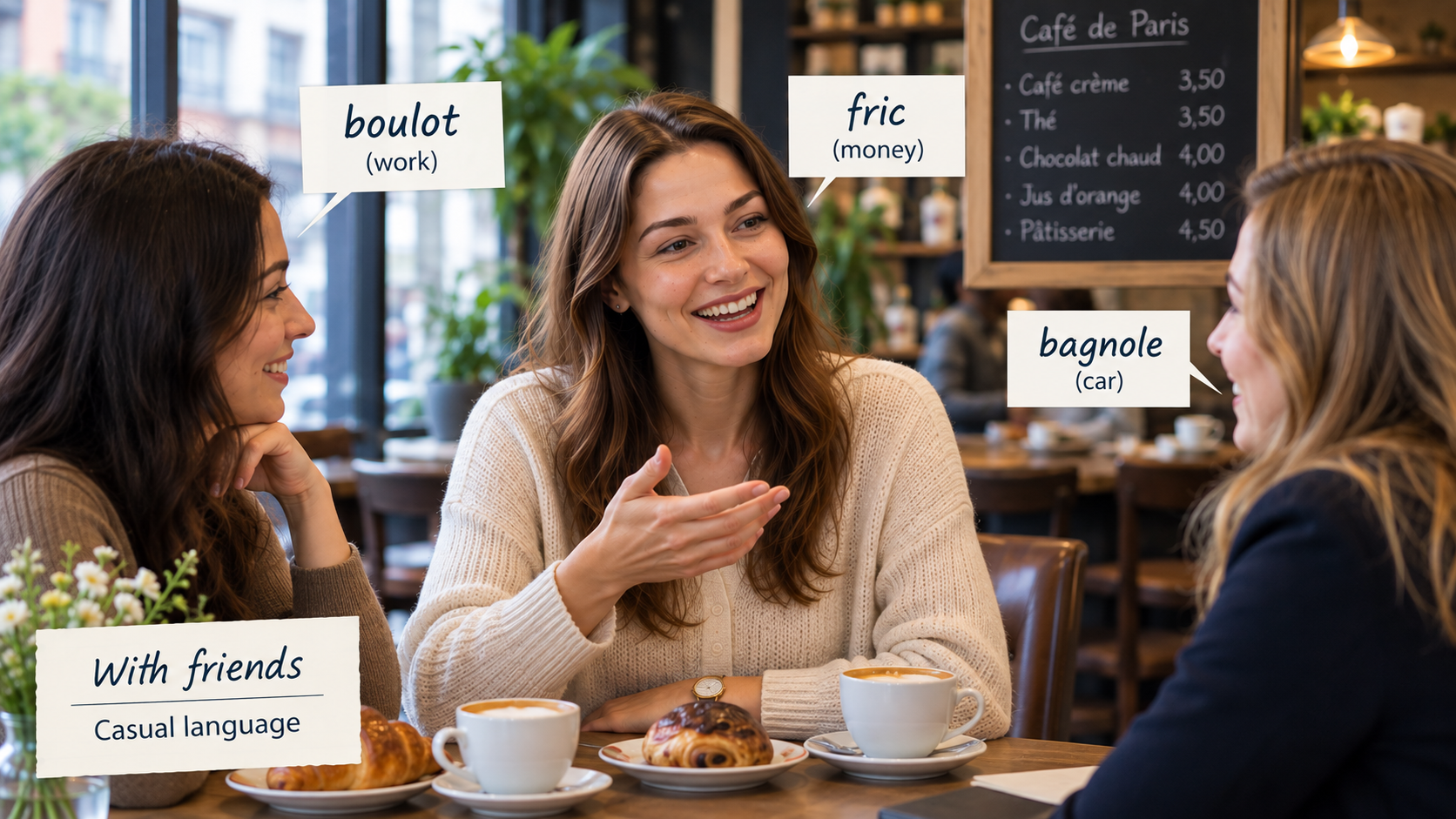
For example, travail is a common word for “work,” but boulot is also frequently used in everyday conversation. Similarly, argent can be replaced by fric in informal contexts, while voiture may be replaced by bagnole when referring to a car.
Although these words have similar meanings, they cannot be used interchangeably in every situation. A word that sounds natural in a conversation with friends may sound too informal in a professional document. In other words, it is important to choose vocabulary according to factors such as your relationship with the other person, the context of the conversation, and the type of text you are writing.
In this article, I will explain how French vocabulary changes according to the situation, using specific expressions as examples.
In French, it is necessary to choose appropriate vocabulary according to whether the situation is formal or casual and according to your relationship with the other person.
For example, one of the most common verbs meaning “to eat” is manger.
Manger can be used in a wide range of contexts, from everyday conversation to written French. In casual situations, however, the verb bouffer is sometimes used.
Bouffer also means “to eat,” but it is more informal than manger. It may be used in conversations with close friends or family members, but manger is more appropriate when speaking with professional contacts or writing in a formal context.
Such differences are not limited to verbs. For example, “work” is generally expressed as travail, while boulot is also commonly used in casual conversation. Similarly, voiture is the standard word for “car,” while bagnole may be used in colloquial speech.
In other words, simply knowing the meaning of a French word does not necessarily mean that you can use it naturally. Even words with similar meanings may be appropriate in different contexts, such as conversations with friends, workplace discussions, news reports, and administrative documents.
The relationship between the speaker and the listener also affects vocabulary choices. Informal expressions may be appropriate with someone you know well, but using the same words with someone you have just met or with a person in a position of authority may sound overly familiar in some situations. Conversely, using highly formal vocabulary in an everyday conversation with a friend can sound unnecessarily stiff.
For this reason, when learning French vocabulary, it is important to consider not only “What does this word mean?” but also “Who is it used with, and in what situations?”
An important concept for understanding these differences is the French linguistic register, or registre de langue.
This refers to differences in language use according to factors such as the person being addressed, the situation, and the type of text. Just as the language used in English or Japanese changes between a conversation with a friend and a professional email, French vocabulary and expressions also vary depending on the context.
French registers are generally divided into three broad categories:
Registre courant refers to standard language that can be used in a wide range of everyday situations. It is generally appropriate when speaking with someone for the first time or communicating in the workplace, and much of the vocabulary introduced to French learners at an early stage falls into this category.
Registre familier is commonly used in conversations with family members, friends, and other people with whom the speaker has a close relationship. It may involve colloquial vocabulary that differs from standard vocabulary. Grammatical elements may also be omitted in spoken language, as when Je ne sais pas. becomes Je sais pas.
By contrast, registre soutenu is a formal or elevated style of language found in contexts such as formal writing, speeches, and literature. It may involve vocabulary and grammatical constructions that are uncommon in everyday conversation and can create a highly refined or formal impression.
Even vocabulary related to the concept of a “house” can illustrate differences in register:
Maison is the most common word for “house” and can be used in a wide range of contexts.
Depending on the context, demeure can have a formal or literary tone. Baraque, by contrast, is colloquial and may carry the nuance of a modest or poorly constructed house.
However, not every word can be clearly assigned to one of these three registers. Some words are used across several contexts, and their connotations may change depending on the situation. Perceptions of particular words may also vary according to region and generation.
It is therefore useful to think of registre de langue as a framework for considering who uses a particular expression, with whom, and in what circumstances.
In everyday French conversation, casual expressions belonging to registre familier are frequently used instead of the standard words typically introduced first in textbooks.
Some common examples include:
Words such as boulot and fric are widely used in conversations between people who know each other well and can also frequently be heard in films and television dramas.
Using informal vocabulary can also reflect the closeness of the relationship between the speaker and the listener. For example, using words such as boulot and bouquin among friends can create a more familiar and relaxed tone.
In formal documents or professional writing, however, standard vocabulary such as travail and livre is generally more appropriate.
In workplaces and business emails, standard vocabulary associated primarily with registre courant is commonly used. Colloquial expressions that sound natural among friends may sound too casual when used with professional contacts or people you have just met.
For example, when referring to “work,” boulot may be used in a conversation with a friend, while travail is generally more appropriate in professional conversations and documents.
In business emails and official documents, more formal vocabulary may also be selected depending on the context. For example, solliciter (“to request” or “to seek”) may be used as a more formal alternative to demander (“to ask” or “to request”).
The way a request is expressed also changes depending on the relationship between the speakers. With a friend, you might say Tu peux m’aider ? (Can you help me?), whereas with a professional contact, a more polite expression such as Pourriez-vous m’aider ? (Could you help me?) would generally be more appropriate.
Of course, a formal situation does not mean that difficult vocabulary must always be used. What matters is avoiding slang or excessively casual expressions and choosing language that is natural, clear, and appropriate for the context.
In contexts such as administrative documents, journalism, law, and business, more formal and precise vocabulary may be chosen instead of words commonly used in everyday conversation.
For example, the general verb meaning “to die” is mourir, which can be used in a wide range of situations, including everyday conversation.
When formally reporting a death, however, décéder is commonly used.
In this way, décéder is a formal expression commonly found in contexts such as death announcements, news reports, and official records.
Similarly, the verbs habiter and résider may both be translated as “to live” or “to reside,” but their use can differ depending on the context.
Habiter is generally the more common verb, while résider may be used in administrative procedures or official writing when referring formally to a person’s place of residence.
Likewise, while acheter is the common verb meaning “to buy,” acquérir is often used in more formal contexts.
Acquérir does not simply refer to buying goods; it can also mean acquiring property, rights, or other assets. For this reason, it is frequently found in writing related to real estate, business activities, and law.
In French, vocabulary and expressions vary not only according to the relationship between speakers and the situation but also according to whether the language is spoken or written.
Everyday conversation takes place in real time, so short, simple expressions and colloquial vocabulary are common. Written language in newspapers, official documents, and analytical or argumentative texts, by contrast, often uses standard or more formal vocabulary in order to convey meaning clearly and precisely.
For example, the demonstrative pronoun cela, meaning “this” or “that,” is commonly found in relatively formal contexts and written French. In everyday spoken French, ça is extremely common.
Grammatical elements may also be omitted in spoken French. One particularly clear example can be found in negative constructions.
The standard form is Je ne sais pas. (I don’t know), but in conversation, ne is frequently omitted, resulting in Je sais pas.
However, the boundary between spoken and written French is not always clearly defined, and factors such as individual speaking habits and linguistic conventions also play a role. It is therefore important to judge flexibly how formal your language should be according to your audience, the medium, and the context.
In French, vocabulary and expressions vary according to the relationship between speakers and the situation in which the language is used.
The main points can be summarized as follows:
When expanding your French vocabulary, it is important to understand the situations in which each word is normally used.
By paying attention to differences in vocabulary according to context, you can choose French expressions that are more appropriate for both the person you are addressing and the situation.