#12 Swiss French
Izumi Miyajima French Forest
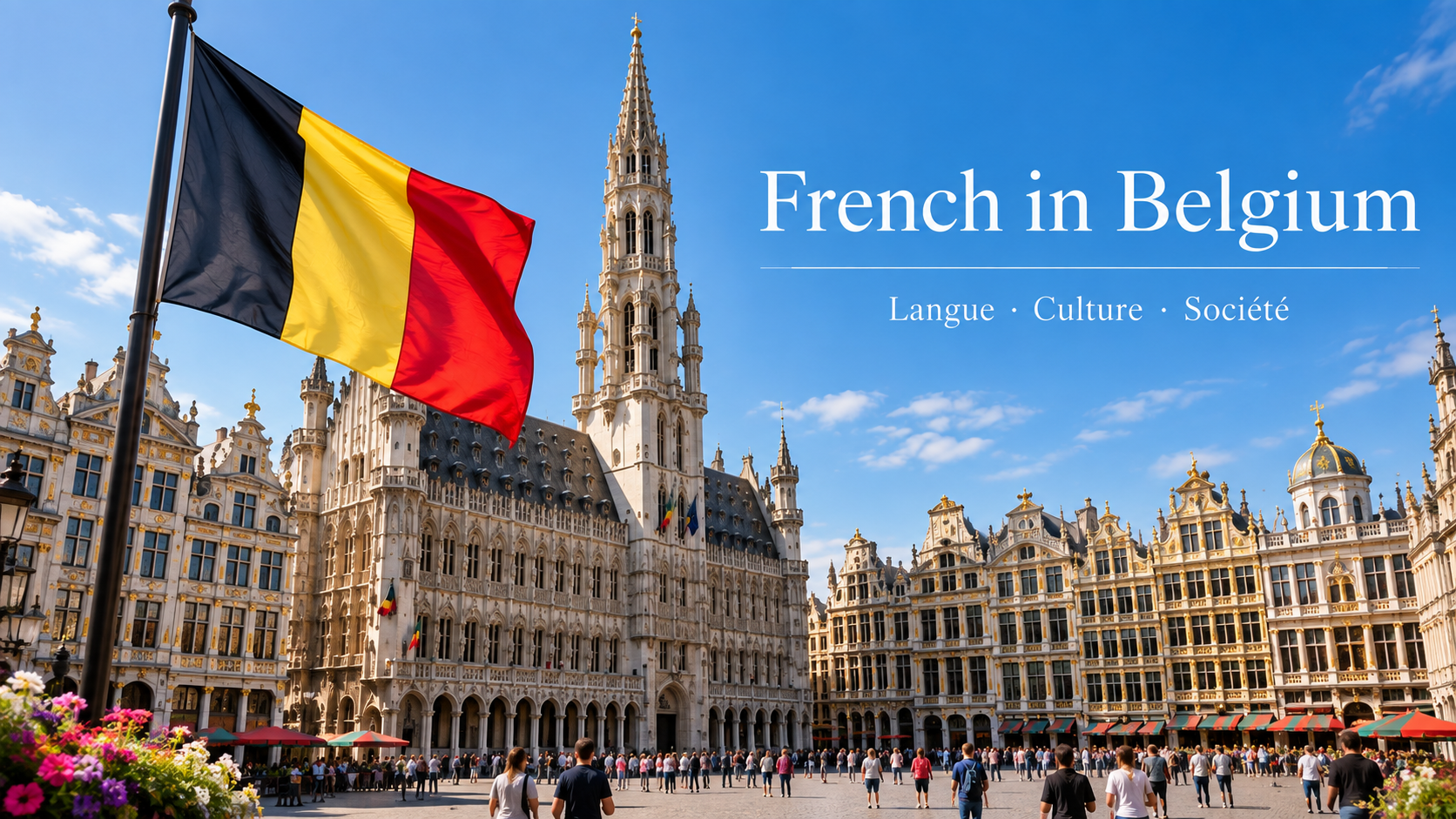
Belgium is a multilingual country with several distinct linguistic regions. Dutch is primarily spoken in the north, French in the south, and German in a small area in the east.
Among these languages, French plays an important role in Belgian society. It is widely spoken, particularly in the southern region of Wallonia, and is also commonly used in everyday life in the capital, Brussels.
The French spoken in Belgium shares essentially the same grammar and spelling as the French spoken in France, so speakers from the two countries can generally communicate without difficulty. However, Belgian French has some distinctive features, particularly in the way numbers are expressed and in certain aspects of everyday vocabulary.
These differences have developed through Belgium’s complex linguistic history and its long-standing contact with surrounding languages, especially Dutch.
In this article, I will explain how French is used in Belgium, how it differs from the French spoken in France, and the historical and social background behind these differences.
Belgium has three official languages: Dutch, French, and German.
The predominant language varies by region, and language is closely connected with administration, education, politics, and other aspects of Belgian society.
Dutch is primarily spoken in Flanders in northern Belgium, while French is the main language in Wallonia in the south. There is also a German-speaking area in eastern Wallonia. Although German speakers represent a small proportion of Belgium’s total population, they form a distinct linguistic community.
Brussels, the capital, is surrounded by Flanders but constitutes the separate Brussels-Capital Region. Both French and Dutch are official languages there.
Today, French is widely used in Brussels, while Dutch also occupies an important position in areas such as administration and education. In addition, Brussels is an international city that is home to institutions of the European Union and other international organizations, as well as residents with roots in many different countries. As a result, English and many other languages are also commonly used.
Belgium also has three language-based communities: the Flemish Community, the French Community, and the German-speaking Community. These communities are responsible for areas such as culture and education.
Belgium is therefore a multilingual country in which the predominant language differs from one region to another, with French playing an important role as one of its major languages.
Several languages were historically spoken in the territory that now forms Belgium.
In the south, Walloon and other Romance languages related to French were traditionally spoken. In the north, people spoke various Dutch dialects that were closely related to the language that developed into modern Dutch. These linguistic differences existed long before Belgium became an independent country.
The territory of present-day Belgium was once ruled by the Spanish and Austrian branches of the Habsburg dynasty and came under French rule at the end of the eighteenth century. Following the end of the Napoleonic Wars, it became part of the United Kingdom of the Netherlands in 1815, together with the territory of the present-day Netherlands and other areas.
In 1830, however, the Belgian Revolution broke out, leading to Belgium’s independence from the Netherlands.
After independence, French acquired a powerful position in politics, administration, the judiciary, higher education, and other areas of public life. At the time, French was widely used in European diplomacy and among the upper classes, and it also enjoyed considerable social prestige in Belgium. As a result, French was used not only in the French-speaking south but also by some members of the upper classes and educated elites in the Dutch-speaking north.
However, this does not mean that most Belgians at the time spoke French as their native language. In Flanders in particular, a large proportion of the population continued to speak Dutch dialects in everyday life.
Against this background, the nineteenth century saw the development of the Flemish Movement, which sought to improve the status of Dutch. Over time, the official position of Dutch gradually became stronger.
During the twentieth century, Belgium’s linguistic regions became more clearly defined. In the 1960s, the language border was legally established, institutionalizing the north as primarily Dutch-speaking, the south as primarily French-speaking, and a small area in the east as German-speaking. Brussels was established as a bilingual French-Dutch region.
French is therefore spoken in Belgium not simply because the country borders France. Its presence is deeply connected both to the long history of Romance languages in the south and to the major role that French played in politics, administration, education, and other areas following Belgian independence.
Belgium’s present-day linguistic landscape, characterized by the coexistence of French, Dutch, and German, is the result of this long historical development.
Brussels is particularly interesting when considering Belgium’s linguistic situation.
Geographically, Brussels is surrounded by Dutch-speaking Flanders, but it now forms the separate Brussels-Capital Region, where both French and Dutch are officially used. In everyday life, French is also widely spoken by residents.
However, French was not always the predominant language of Brussels. Historically, Dutch varieties, particularly the Brabantian dialect, were widely spoken in Brussels and the surrounding area.
The situation changed significantly from the nineteenth century onward. Following Belgian independence in 1830, French occupied a strong position in politics, administration, the judiciary, higher education, and other areas. At the time, French was also a language of considerable social prestige and was associated with opportunities for education and social advancement.
As a result, an increasing number of people who had originally spoken Dutch varieties began using French in their everyday lives. Brussels also developed rapidly as the national capital, attracting people from different parts of Belgium, which further contributed to the expansion of French.
From the late nineteenth century onward, however, the official status of Dutch was gradually strengthened. Today, both French and Dutch are used officially in the Brussels-Capital Region, and public administration is organized to provide services in both languages.
Modern Brussels is also home to people from Belgium and many other parts of the world. Consequently, it has developed into a highly multilingual society in which English, Arabic, and numerous other languages are used in homes and everyday life.
The widespread use of French in Brussels today is therefore the result of several historical and social factors, including the social status of French following Belgian independence, the development of Brussels as the national capital, and patterns of population movement.
The French spoken in Belgium is fundamentally the same language as the French spoken in France, and the two varieties share almost all of their standard grammar and vocabulary. As a result, French speakers from Belgium and France can generally communicate without difficulty.
Nevertheless, there are some differences in everyday vocabulary, expressions, and the way certain numbers are expressed.
For example, in France, 70 is generally expressed as soixante-dix and 90 as quatre-vingt-dix. In Belgium, septante (70) and nonante (90) are widely used instead.
In Belgium, the meals of the day are commonly referred to as déjeuner (breakfast), dîner (lunch), and souper (dinner). In France, by contrast, petit-déjeuner (breakfast), déjeuner (lunch), and dîner (dinner) are generally used.
In other words, déjeuner and dîner can refer to different meals in Belgium and France.
Words and expressions characteristic of Belgian French are known as Belgicismes. These include not only expressions that developed specifically in Belgium but also older usages that are no longer common in France, as well as forms that emerged through contact with Dutch and other surrounding languages.
However, vocabulary and pronunciation also vary within Belgium according to region, generation, and speakers’ social backgrounds. Regional characteristics tend to be more noticeable in informal everyday conversation, while the standard French used in news broadcasts, education, and official contexts generally differs relatively little from that used in France.
The relationship between French and Dutch is also important when considering Belgian French.
French and Dutch have long been used alongside each other within Belgian society. In areas where the two languages have been in close contact, particularly Brussels, French and Dutch speakers have interacted through everyday life, work, and other social activities.
As a result, Belgian French contains vocabulary and expressions that have entered the language through contact with Dutch and with dialects traditionally spoken in northern Belgium.
One representative example is kot. In Belgian French, this word primarily refers to a room or accommodation occupied by a student and is used in expressions such as un kot étudiant.
The word kot is also found in Dutch, where it originally refers to a small hut, shed, or cramped room. In Belgian French, it has become closely associated with student life, and the verb koter is also used. This generally means “to live in student accommodation” or “to live away from home in a student room.”
Another example found in Belgian French is dringuelle. The word means a “tip” or small gratuity and comes from the Dutch drinkgeld. Its frequency and contexts of use today vary according to region and generation, but it provides one example of the long history of linguistic contact between French and Dutch in Belgium.
In other cases, older French vocabulary and usages have survived in Belgium, while some expressions have developed independently within the country.
Belgian French has therefore inherited the broader history of the French language while also developing distinctive vocabulary and expressions through long-term contact with Dutch and other surrounding languages.
Belgium is one of the major French-speaking countries in Europe.
The main points can be summarized as follows:
Belgian French shares its fundamental grammar and vocabulary with the French spoken in France while also having its own distinctive expressions and pronunciation.
Understanding these differences shows how French has developed in diverse ways in different regions, closely connected with their particular histories and societies.