#6 The Standardization of French
Izumi Miyajima French Forest


Modern French follows established conventions governing the spelling of words and the use of accent marks.
These orthographic conventions gradually developed over a long period, undergoing various changes throughout history.
In medieval France, spelling varied according to region and individual writers. Over time, developments such as the spread of printing technology, the compilation of dictionaries, and the expansion of formal education contributed to the standardization of French spelling.
The Académie française, established in the seventeenth century, played a particularly important role in organizing and standardizing French vocabulary and spelling.
French orthography also continues to evolve. In 1990, a set of proposed reforms was published to make French spelling more consistent and regular.
In this article, I will explain how French orthography emerged and developed into its modern form, examining important historical events and specific changes in spelling.
To understand the history of French orthography, it is important to begin by examining how the French language developed and came to be recorded in writing.
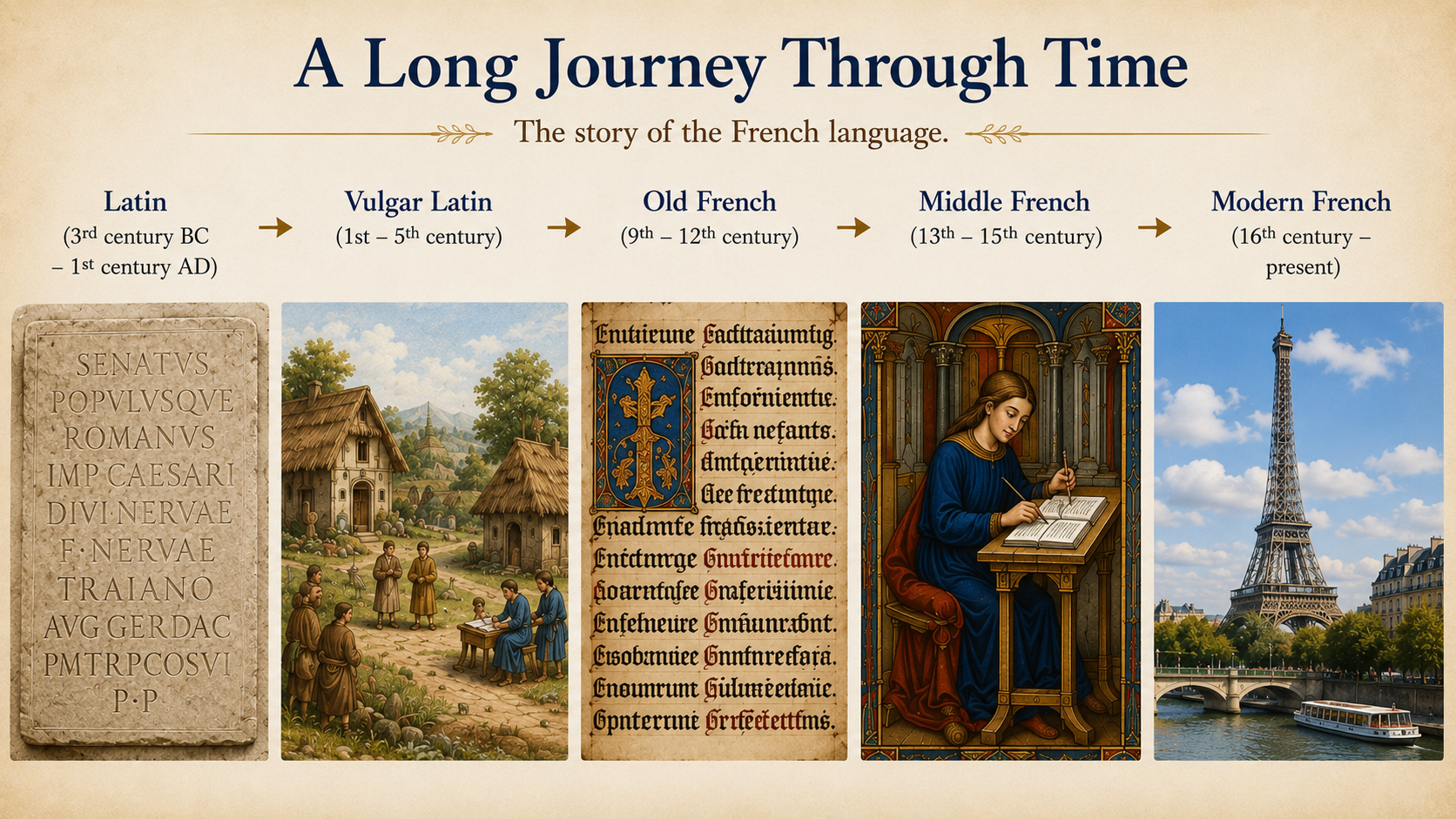
French is one of the Romance languages that developed from Latin, which was widely spoken throughout the ancient Roman Empire.
Latin spread across the territory corresponding to present-day France through Roman rule. Over time, regional changes in pronunciation, vocabulary, and grammar gradually led to the development of Old French.
However, while the spoken language continued to evolve, Latin remained the principal language of written communication for many centuries. In early medieval Europe, Latin played an important role in religion, scholarship, and administration, and many documents in France were written in Latin.
As a result, the language spoken in everyday life gradually became increasingly different from the language used in official documents.
Against this background, attempts began to emerge to record the developing spoken Romance language using the Latin alphabet.
One of the most important early examples is the Oaths of Strasbourg, dating from 842.
This document preserves features of the Romance language used in the West Frankish Kingdom at the time, providing valuable evidence of the linguistic forms that eventually developed into French.
Another important early French text is the Sequence of Saint Eulalia, composed in the second half of the ninth century. This religious poem recounts the martyrdom of Saint Eulalia and provides valuable evidence of literary expression in the Romance language of that period.
At the time these documents appeared, French spelling was still in the early stages of development, and various written forms were used according to region and individual writers.
In medieval France, different languages and dialects were spoken across the country, and considerable variation could also be found in written French.
In northern France, the langues d’oïl, including Old French, developed, while Occitan and other languages were widely spoken in the south. Regional linguistic differences also existed within northern France, including varieties such as Picard and Norman.
At the time, a unified system of French orthography had not yet been fully established, and the same word could be written differently depending on the region or the writer.
During the twelfth and thirteenth centuries, French came to be used increasingly in literary works, legal documents, and other written materials. As a result, conventions for representing the language in writing gradually became more established.
Furthermore, as royal authority and administrative institutions developed during the late medieval and early modern periods, written conventions associated with Paris and its surrounding region increasingly influenced the standardization of French.
In 1539, King Francis I issued the Ordinance of Villers-Cotterêts, which required the use of French in judicial documents and procedures. This measure accelerated the transition from Latin to French in official documentation and strengthened the position of French as a written language.
Thus, from the Middle Ages through the sixteenth century, French spelling developed amid considerable regional variation while gradually becoming more established as a written language used in literature, administration, and other fields.
French orthography underwent significant changes during the fifteenth and sixteenth centuries.
During this period, the Renaissance stimulated renewed interest in the culture and scholarship of ancient Greece and Rome throughout Europe.
In France, scholars familiar with Latin and Greek increasingly emphasized the origins and historical development of French words. As a result, there was a growing tendency to use spelling to reflect a word’s relationship with its Latin or Greek origins, rather than representing pronunciation alone.
For example, modern French contains words such as:
These words contain consonant letters that are generally not pronounced. Some of these letters were retained or introduced to reflect connections with Latin word forms.
For example, doigt derives from the Latin digitus, and the g in its modern spelling reflects this etymological connection.
Similarly, compter derives from the Latin computare, and the p in its spelling reflects the Latin form. The word corps comes from the Latin corpus, and its p also preserves a connection with its etymological origin.
Such spellings provide clues to the languages and historical forms from which French words developed.
During the sixteenth century, however, some scholars argued that spelling should more closely reflect actual pronunciation. One of the most prominent figures advocating this approach was the French grammarian Louis Meigret.
Meigret emphasized the importance of representing French pronunciation more accurately in writing and proposed orthographic reforms in the middle of the sixteenth century.
At the time, French spelling varied according to region and individual writers, making the relationship between pronunciation and written forms an important subject of discussion. Consequently, debates arose between those who emphasized etymology and traditional spelling and those who favored spelling based more closely on actual pronunciation.
These debates increased awareness of the need to standardize French spelling and contributed to later efforts to establish more consistent orthographic conventions.
The spread of printing technology also played a major role in the development of French orthography.
With the development of movable-type printing in Europe during the middle of the fifteenth century, books could be produced in much larger quantities. Printing expanded in France during the second half of the fifteenth century, and cities such as Paris and Lyon became important publishing centers.
Before the spread of printing, books were primarily reproduced by scribes who copied manuscripts individually. As a result, the same word could appear in different spellings depending on a scribe’s regional background or writing conventions.
Printed books, by contrast, made it possible to distribute identical texts to large numbers of readers. Printers increasingly adopted particular spelling and punctuation conventions to maintain consistency throughout their publications.
As printed books circulated across wider geographical areas, particular spellings became familiar to larger numbers of readers. The written conventions used in major publishing centers, especially Paris, had a significant influence on the development of written French.
The development of printing also contributed to the wider use of accent marks.
Modern French uses marks such as é, è, ê, à, and ù, but the conventions governing these forms developed gradually over time.
During the sixteenth century, printers and scholars helped popularize the use of accent marks. The printer and scholar Robert Estienne, in particular, is known for his contributions to the organization of French spelling through dictionary compilation and publishing.
The growing availability of printed dictionaries and grammar books also made it easier for readers and writers to consult established spellings and conventions for using accent marks, providing a foundation for the wider adoption of common written forms.
In this way, printing technology not only enabled the mass production of books but also played an important role in spreading shared spelling conventions across France and promoting the standardization of French orthography.
During the seventeenth century, efforts to standardize French orthography became increasingly prominent.
The institution that played a central role in this process was the Académie française, established in 1635.
At the time, the strengthening of royal authority and the development of administrative institutions increased the use of French in official contexts. French was also becoming more important in literature and scholarship, creating greater awareness of the need to organize its vocabulary, grammar, and spelling.
Against this background, the Académie française was established with the support of Cardinal Richelieu, the chief minister of King Louis XIII.
The Académie française was founded to organize French vocabulary, grammar, and usage and to establish linguistic standards.
One of its most important activities was the compilation of a French dictionary.
In 1694, the first edition of the Dictionnaire de l’Académie française was published. This dictionary organized contemporary French vocabulary and spelling and had a significant influence on the subsequent development of French orthography.
The first edition showed a tendency to emphasize etymology and traditional written forms. For example, the modern word tête (head) was written teste, while fête (festival, celebration) appeared as feste.
These spellings preserved consonant letters used in earlier periods. In later orthographic conventions, these forms were replaced by spellings using the circumflex accent.
At the time, some French words could also be written in more than one way. The compilation of dictionaries played an important role in organizing these variations and promoting common spellings.
Orthographic standardization continued over a long period, and successive editions of the Académie française dictionary incorporated changes in vocabulary and spelling according to the linguistic conventions of their time.
During the eighteenth century in particular, spelling simplification and the organization of accent marks progressed, helping establish orthographic conventions closer to those used in modern French.
Significant changes were introduced to French orthography during the eighteenth century. Particularly important were the third and fourth editions of the Dictionnaire de l’Académie française, published in 1740 and 1762, respectively.
During this period, alongside the desire to preserve traditional spellings, there was a growing movement to organize written forms more closely according to actual pronunciation. As a result, the spellings of many words were modified, and forms resembling those used in modern French became more widespread.
One representative development was the removal of an unpronounced s and the use of the circumflex accent (ˆ).
For example, the following changes can be observed:
| Older Spelling | Modern Spelling | Meaning |
|---|---|---|
| teste | tête | head |
| feste | fête | festival, celebration |
| forest | forêt | forest |
| hospital | hôpital | hospital |
In these words, an s following a vowel had ceased to be pronounced during the historical development of French and was subsequently removed from the spelling.
The circumflex accent was then placed over the vowel in these words, reflecting the historical position of the former s.
Another important development during the eighteenth century was the replacement of final y with i in certain words.
For example, the modern words foi (faith), loi (law), and roi (king) were previously written foy, loy, and roy.
The 1740 dictionary revision standardized the spellings of such words and adopted forms that led to their modern written equivalents.
The use of accent marks also expanded, and conventions involving é, è, ê, and other accented letters became more established as ways of representing differences in vowel pronunciation.
The 1740 dictionary revision, in particular, considerably expanded the use of the grave accent (è), reflecting efforts to represent vowel pronunciation more clearly in spelling.
These changes were intended to make French spelling more regular and easier to understand. According to the Académie française, approximately 8,000 spellings were modified across the dictionary revisions of 1740 and 1762.
The eighteenth century was therefore a major turning point in the development of French orthography, during which many spelling conventions used today became established.
During the second half of the twentieth century, discussions continued about making French orthography more regular and easier to learn.
French spelling still contained irregular forms inherited from its long history, including spellings whose relationship with pronunciation was difficult to understand. Consequently, proposals were considered to simplify certain written forms while respecting traditional orthographic conventions.
One of the most important developments was the publication of proposed orthographic reforms in 1990.
These proposals were prepared by the Conseil supérieur de la langue française (Higher Council of the French Language), received the support of the Académie française, and were published in the French Official Journal on December 6, 1990.
Their main objective was to reduce irregularities in spelling and improve orthographic consistency.
The proposals addressed several areas, including the use of accent marks, the spelling of compound words, hyphenation, and the formation of plurals.
For example, the following changes were proposed:
| Traditional Spelling | Revised Spelling | Meaning |
|---|---|---|
| oignon | ognon | onion |
| nénuphar | nénufar | water lily |
| coût | cout | cost |
| paraître | paraitre | to appear, to seem |
| week-end | weekend | weekend |
In oignon, the revised spelling ognon removes the i to bring the written form closer to the word’s pronunciation.
Similarly, nénuphar was simplified to nénufar by replacing the traditional ph with f.
Regarding accent marks, the reforms generally permitted the omission of the circumflex accent (ˆ) over i and u, while retaining it in cases where it was needed to distinguish meanings or grammatical forms.
For example, coût may be written cout, while paraître may be written paraitre. However, traditional accent marks are retained in certain cases where they are necessary to distinguish words or grammatical forms.
The spelling of compound words was also revised. For example, week-end may be written as the single word weekend.
In addition, the rules for forming the plurals of certain hyphenated compound nouns were modified to bring them more closely into line with general French pluralization rules.
The conventions governing the use of hyphens in numbers were also standardized. For example, the traditional spelling deux cent trente-quatre (234) may be written deux-cent-trente-quatre under the revised rules.
Thus, the 1990 reforms sought to improve not only the spelling of individual words but also the overall consistency of French orthography.
However, the reforms were not intended to replace all traditional spellings at once. Instead, both traditional and revised forms were accepted.
As a result, traditional and revised spellings continue to coexist in modern French.
The 1990 reforms are also recognized within the French education system, and revised spellings have been incorporated into dictionaries, textbooks, and other educational materials.
French orthography has developed from the Middle Ages to the present day under the influence of changes in pronunciation, social institutions, printing technology, and dictionary compilation.
The main stages of this historical development can be summarized as follows:
The apparent complexity of French spelling reflects the linguistic changes that have accumulated over many centuries.
For example, the circumflex accents in forêt and hôpital provide clues to older written forms. Similarly, the consonant letters at the ends of words such as temps and corps reflect historical connections with Latin.
Studying the history of French orthography can therefore deepen your understanding of French vocabulary and pronunciation while also providing valuable insight into how the French language developed into its present form.