#24 The Difference Between Tu and Vous
Izumi Miyajima French Forest
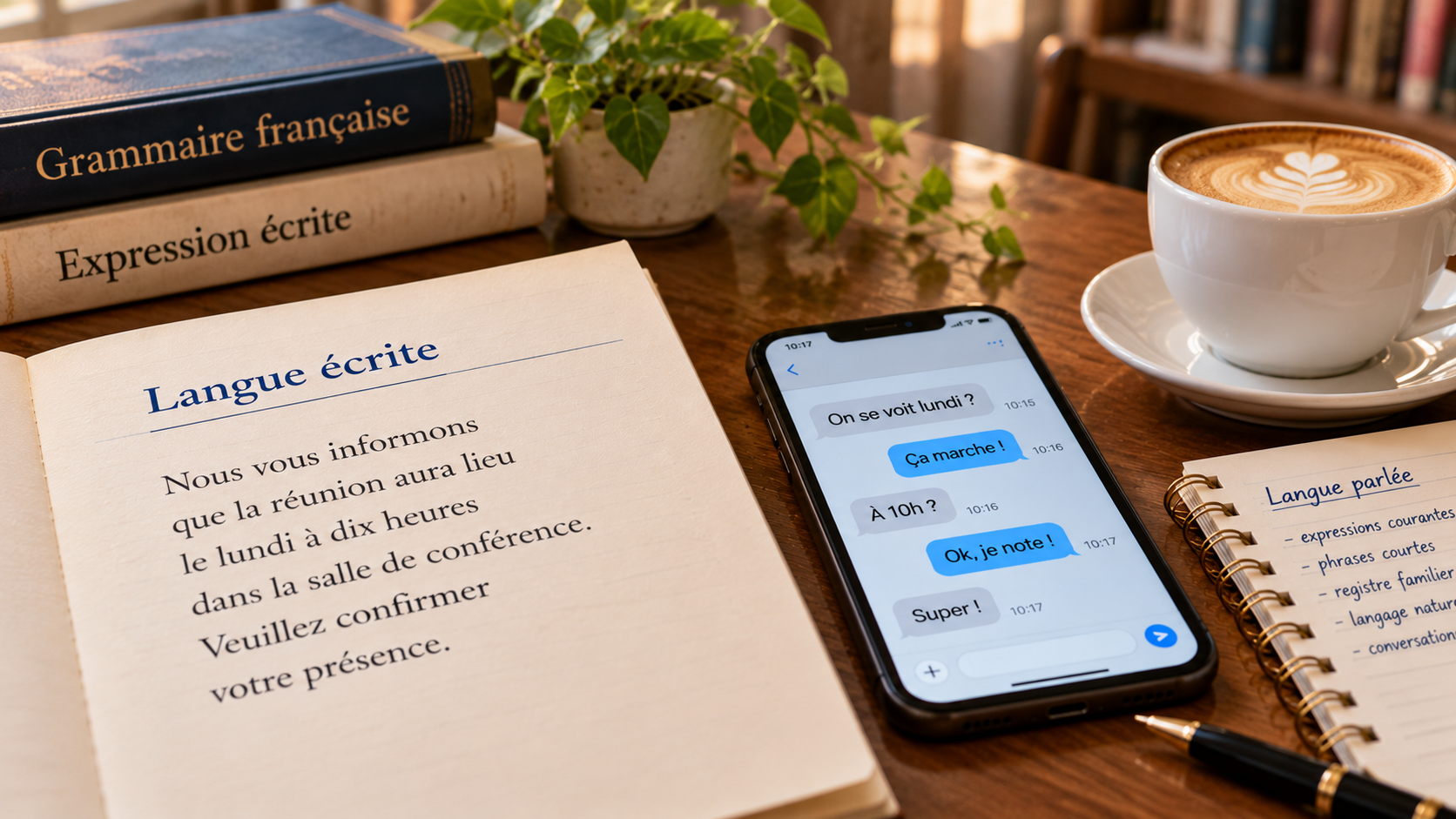
In French, there are various differences between the expressions used in writing and those used in everyday conversation.
Newspapers, books, and official documents tend to use grammatically structured sentences and formal vocabulary. By contrast, conversations with friends and family often involve shorter expressions and more informal language.
These differences can be observed not only in vocabulary choices but also in the formation of negative sentences and questions, the use of subject pronouns, and pronunciation.
Furthermore, written French has retained many features of traditional grammar and spelling, while new expressions and patterns of usage have gradually become widespread in spoken French.
Understanding the characteristics of both written and spoken French is therefore essential for accurately understanding the language and using it naturally in different situations.
In this article, I will explain the differences between written and spoken French, focusing on specific aspects of grammar, vocabulary, and pronunciation.
Written and spoken French share essentially the same grammatical system and vocabulary, but they exhibit different characteristics depending on the situation and method of communication.
Written French is used in newspaper articles, books, business documents, and formal emails. In general, it emphasizes clear grammatical structures and logical connections throughout a text.
Written communication also requires information to be organized and explained so that readers can understand the content without being physically present. As a result, writers tend to use conjunctions to clarify relationships between sentences and select precise vocabulary.
Spoken French, on the other hand, is used in conversations with friends and family, workplace interactions, and telephone calls. Because speakers can observe and respond to their listeners’ reactions, they may omit information that is already clear from the context or use shortened expressions.
In spoken communication, tone of voice, intonation, and pauses also play important roles in conveying meaning.
For example, the question “Are you coming tomorrow?” can be expressed in several ways:
All three are grammatically valid questions, but the first, which uses subject–verb inversion, creates a relatively formal impression.
By contrast, Vous venez demain? maintains the normal word order and uses intonation to indicate a question. This structure is particularly common in everyday conversation.
Written French also takes various forms. For example, messages to friends and social media posts may use expressions that closely resemble spoken language.
Thus, in French, it is important to choose appropriate expressions not only according to whether communication is written or spoken but also according to the relationship between the participants and the situation.
One of the most characteristic differences between written and spoken French concerns the formation of negative sentences.
In standard French, negation is generally formed by combining ne and pas around the verb.
In everyday conversation, however, ne is frequently omitted, resulting in expressions such as:
In these spoken forms, the negative meaning remains clear because pas continues to express negation even when ne is omitted.
The omission of ne also occurs with negative expressions other than pas.
For example, Je ne comprends rien. (I do not understand anything) may become Je comprends rien. in everyday conversation. Similarly, Je ne vois personne. (I cannot see anyone) may be expressed as Je vois personne.
In Old French, ne was originally the principal element expressing negation. Over time, words such as pas began to be used to reinforce negative statements, and the construction ne … pas gradually became established.
In modern French, the omission of ne has become increasingly widespread in spoken language, with words such as pas carrying the primary negative meaning.
However, negative constructions that include ne remain standard in official documents, newspaper articles, and business emails.
For this reason, French learners should first become familiar with standard negative constructions such as ne … pas.
In French, nous is a subject pronoun meaning “we.”
In everyday conversation, however, on is widely used instead of nous. The preceding sentences can therefore be expressed as follows:
Originally, on is an indefinite pronoun referring to unspecified people, with meanings such as “one” or “people in general.” However, it is also frequently used to mean “we.”
For example, On dit que ce restaurant est excellent. means “People say that this restaurant is excellent.”
An important point to remember is that nous and on require different verb conjugations.
When nous is the subject, the verb takes the first-person plural form. When on is the subject, the verb takes the third-person singular form, even when on means “we.”
For example, “We are going” is expressed as Nous allons. with nous, but On va. with on.
Similarly, with the regular verb parler (to speak), Nous parlons. becomes On parle. when on is used as the subject.
French has several ways of forming questions, and the forms most commonly used differ between written and spoken language.
The three main methods are subject–verb inversion, questions using est-ce que, and questions formed through intonation.
For example, “Do you speak French?” can be expressed in the following ways:
The first form, Parlez-vous français?, uses inversion of the verb and subject pronoun. Inversion is used in formal writing, official situations, and polite questions. It is particularly common as a traditional question structure in formal written French.
The second form, Est-ce que vous parlez français?, forms a question by placing est-ce que at the beginning of the sentence.
This construction is used in both written and spoken French. Because it does not require changing the order of the subject and verb, it is also relatively easy for French learners to use.
The final form, Vous parlez français?, maintains the normal word order and indicates a question through intonation.
This structure is especially common in everyday conversation. It is frequently used among people who know each other well, but it can also sound natural in workplaces and other situations depending on the context.
When learning how to form questions in French, it is therefore important to understand both their grammatical structures and the situations in which each form is commonly used.
In French, different words may be used to express similar meanings depending on the relationship between speakers and the conversational context.
For example, travail is a common word for “work,” but boulot is also frequently used in everyday conversation. Similarly, argent is the standard word for “money,” while fric is a more informal alternative.
Some representative examples include:
| Standard Vocabulary | Informal Vocabulary | Meaning |
|---|---|---|
| travail | boulot | work |
| argent | fric | money |
| voiture | bagnole | car |
| ami | pote | friend |
| livre | bouquin | book |
| nourriture | bouffe | food |
Although these words have similar meanings, they create different impressions depending on the context.
For example, J’ai beaucoup de boulot. (I have a lot of work) sounds natural in a conversation with a friend, whereas J’ai beaucoup de travail. is generally more appropriate in a formal business document.
French also has a form of slang formation known as verlan, which involves rearranging the syllables or sounds of words to create new expressions.
Examples include meuf, derived from femme (woman), and chelou, derived from louche (suspicious).
Such expressions are used in youth culture and informal conversations, although their frequency of use varies according to generation, region, and social environment.
They may also appear in written contexts, including social media posts, messages between friends, and dialogue in literary works.
In written French, sentences tend to be structured so that the relationships between subjects, verbs, objects, and other elements are clear.
In spoken French, however, word order may be adjusted to emphasize particular information or make the topic easier for the listener to identify.
For example, compare the following sentences:
The first sentence follows a standard grammatical structure, with Ce livre functioning as the subject.
In the second sentence, Ce livre is placed at the beginning to introduce the topic, and the pronoun il subsequently refers to the same object.
This construction is particularly common in spoken French.
In these sentences, the initial phrase introduces the topic, which is then followed by information about it.
Spoken French can also place the topic at the end of a sentence.
In this case, the speaker first expresses an opinion about the book and then specifies what is being discussed.
Thus, spoken French frequently uses flexible word order to convey information by drawing on the flow of conversation and the shared understanding between speakers.
In written French, it is important to connect information logically so that readers can easily follow the development of a text.
In newspaper articles, argumentative essays, and business documents in particular, conjunctions and adverbs are frequently used to clarify relationships such as cause and effect, contrast, and the addition of information.
Common examples include:
These expressions clarify the relationships between different parts of a text and help readers understand its content.
Written French also places considerable emphasis on the overall organization of a text.
For example, a common structure involves presenting a main argument, explaining the reasons supporting it, and then providing specific examples or a conclusion. Each paragraph has a clear function, and connecting expressions are used to present information in a logical sequence.
In spoken French, by contrast, speakers may add explanations in response to their listeners’ reactions or change topics during a conversation.
As a result, expressions such as bon, ben, alors, and en fait are frequently used to introduce a new topic, add explanations, or provide time to think.
These expressions are known as “discourse markers.” They help organize the flow of conversation and signal how the discussion is developing.
Written and spoken French differ in various ways, including pronunciation, grammar, vocabulary, and sentence structure.
The main characteristics can be summarized as follows:
In French, formal and informal expressions are selected according to the relationship between speakers and the situation.
When learning French, it is effective to begin by mastering standard grammar and vocabulary before gradually becoming familiar with expressions characteristic of everyday conversation.
By studying both written and spoken French, learners can develop not only the ability to read French texts accurately but also the skills needed to understand real conversations and respond appropriately in different situations.