#6 The Standardization of French
Izumi Miyajima French Forest
France has a wide variety of surnames, including Martin, Bernard, Dubois, Petit, and Moreau.
When their origins are traced, many French surnames can be found to derive from personal names, occupations, places of residence, and other characteristics.
One reason such surnames emerged was that, as populations grew, it became increasingly difficult to distinguish individuals by a single name alone. As a result, during the Middle Ages, people increasingly began to add references to a person’s place of origin, occupation, parent’s name, or other identifying features in order to distinguish between people who shared the same name.
Over time, these additional names began to be passed down from one generation to the next and gradually became established as hereditary surnames.
In this article, I will explain how French surnames developed and examine representative examples derived from personal names, occupations, place names, and other sources.
In modern France, a person’s name consists of a prénom (given name) and a nom de famille (surname).
For example, in the name Jean Martin, Jean is the prénom and Martin is the nom de famille.
However, the system of inheriting a family surname, as we know it today, did not exist in France from the beginning.
In the early Middle Ages, it was common for people to be identified by a personal name. However, as the population grew and interactions between people expanded, there was an increasing need to distinguish between individuals who shared the same name.
As a result, additional names began to be used alongside personal names, referring to a person’s father or ancestor, occupation, place of origin, place of residence, or other characteristics.
For example, if several people were named Jean, they could be distinguished by descriptions such as “Jean, son of Martin,” “Jean the baker,” or “Jean who lives near the forest.”
At first, such additional names were used to identify particular individuals, but over the course of the Middle Ages, they gradually began to be passed down within families and developed into hereditary surnames. However, the period and process through which surnames became established were not uniform throughout France and varied according to factors such as region and social class.
In this way, surnames that are still used today, such as Martin, Boulanger, Dubois, and Petit, reflect aspects of the society and everyday life of the periods in which they originated.
Many French surnames are derived from personal names.
One representative example is Martin. Martin has long been used as a personal name and is now also widely used as a surname.
Similarly, Bernard, Thomas, Robert, and Richard are all used as personal names but also became established as surnames.
The development of such surnames is connected to the historical practice of using the names of parents or ancestors to distinguish individuals from one another.
For example, if several people named Jean lived in the same village, the name Jean alone would not make it clear which person was being referred to. One way of distinguishing them was therefore to associate an individual with his father’s name, as in “Jean, son of Martin.”
A name used to identify a person on the basis of his or her father’s name is known as a patronymic.
Just as the English surname Johnson historically developed from the meaning “son of John,” the practice of distinguishing individuals through the names of parents or ancestors was found in various parts of Europe.
Therefore, by tracing the origins of common surnames such as Martin, Bernard, Thomas, and Robert, it is possible to see their connections with personal names used in the past and with naming practices based on family relationships.
Some French surnames are derived from occupations practiced in the past.
For example, the French word boulanger means “baker,” and Boulanger is also used as a surname.
Other surnames associated with occupations include:
Berger refers to a shepherd who looks after sheep or other livestock, while meunier refers to a miller who grinds grain into flour. Charpentier, meanwhile, refers to a craftsman who works with timber, particularly in the construction of structural frameworks.
These surnames preserve traces of various occupations that supported everyday life in the Middle Ages, including baking, livestock farming, milling, and woodworking.
However, once occupational names began to be passed down from generation to generation, they came to function simply as family surnames, regardless of the actual occupation of the person who bore them. Therefore, someone with the surname Boulanger today is not necessarily a baker.
The development of surnames from occupations can also be observed in other parts of Europe.
The English surname Smith is associated with blacksmithing, while Baker is connected with baking. The German surname Müller likewise derives from a word meaning “miller.” Although the words themselves differ between languages, they share a common historical pattern in which identifying people by their occupations contributed to the development of surnames.
Studying surnames derived from occupations can therefore reveal not only the meanings of French words but also the types of work that were familiar and important in the societies in which these names developed.
Where a person lived, as well as nearby geographical features and structures, also provided important clues for distinguishing individuals and eventually forming surnames.
In the Middle Ages, people could be identified according to where they lived, with descriptions such as “the person who lives near the forest,” “the person who lives near the bridge,” or “the person who lives on a mountain or elevated area.”
Over time, names associated with such places of residence gradually became established as surnames.
For example, the surname Dubois is related to the French word bois, meaning “wood” or “forest.”
Similarly, the following surnames are associated with places, geographical features, or structures:
Dupont is a surname related to pont, meaning “bridge.” Historically, it is thought to have developed from forms of identification used for people who lived near a bridge or were otherwise associated with one.
The element mont in Dumont means “mountain.” In the past, features of the local landscape, such as forests, bridges, and mountains, were often used as part of a person’s identifying name.
It is also noticeable that many of these surnames contain du.
Du is the contracted form of the preposition de and the definite article le (de + le → du). Together with the noun that follows it, it can express meanings such as “of the” or “from the.”
Dubois contains elements corresponding to du and bois, Dupont to du and pont, and Dumont to du and mont. Historically, these surnames developed from names indicating an association with places or geographical features such as forests, bridges, mountains, or elevated ground.
Thus, some surnames containing du originated from associations with places, geographical features, or structures.
Understanding how these surnames developed shows how people in the Middle Ages used their places of residence and the surrounding landscape to distinguish individuals. It also demonstrates how elements of French vocabulary and grammar have been preserved within surnames.
French is widely spoken throughout France today, but historically, a variety of languages and dialects were used in different parts of the country.
As a result, some surnames preserve features of languages traditionally spoken in particular regions, including Occitan, Breton, Basque, and Germanic languages and dialects.
For example, Occitan was historically spoken widely in southern France. Occitan and French are both Romance languages that developed from Latin, but they underwent different linguistic changes, resulting in differences in vocabulary, pronunciation, and other features.
Some surnames found in southern France are therefore connected with Occitan vocabulary.
For example, the surname Castan is related to the Occitan word castan, referring to a chestnut tree. In standard French, a chestnut tree is called châtaignier, demonstrating how substantially the forms of words referring to the same thing can differ.
In Brittany, meanwhile, Breton, a language belonging to a different linguistic family from French, has traditionally been spoken. Unlike French, which is a Romance language, Breton belongs to the Celtic language family. Surnames of Breton origin can therefore contain vocabulary and forms that differ considerably from those of French.
For example, the Breton word ker, meaning “village,” “settlement,” or “place of residence,” appears in many place names and surnames in Brittany.
Similarly, the surname Bihan derives from the Breton word bihan, meaning “small.” Compared with the standard French word petit, its completely different form is readily apparent.
In Alsace in eastern France, on the other hand, Germanic languages and dialects have historically been spoken. As a result, some surnames found in Alsace, such as Müller and Meyer, reflect features of Germanic languages.
Languages change over time. Pronunciations and word forms evolve, and spelling becomes standardized. As a result, modern French differs in many respects from the French spoken and written in the past.
Surnames, however, are passed down from one generation to another, and they may therefore preserve older words and spellings that are no longer commonly used today.
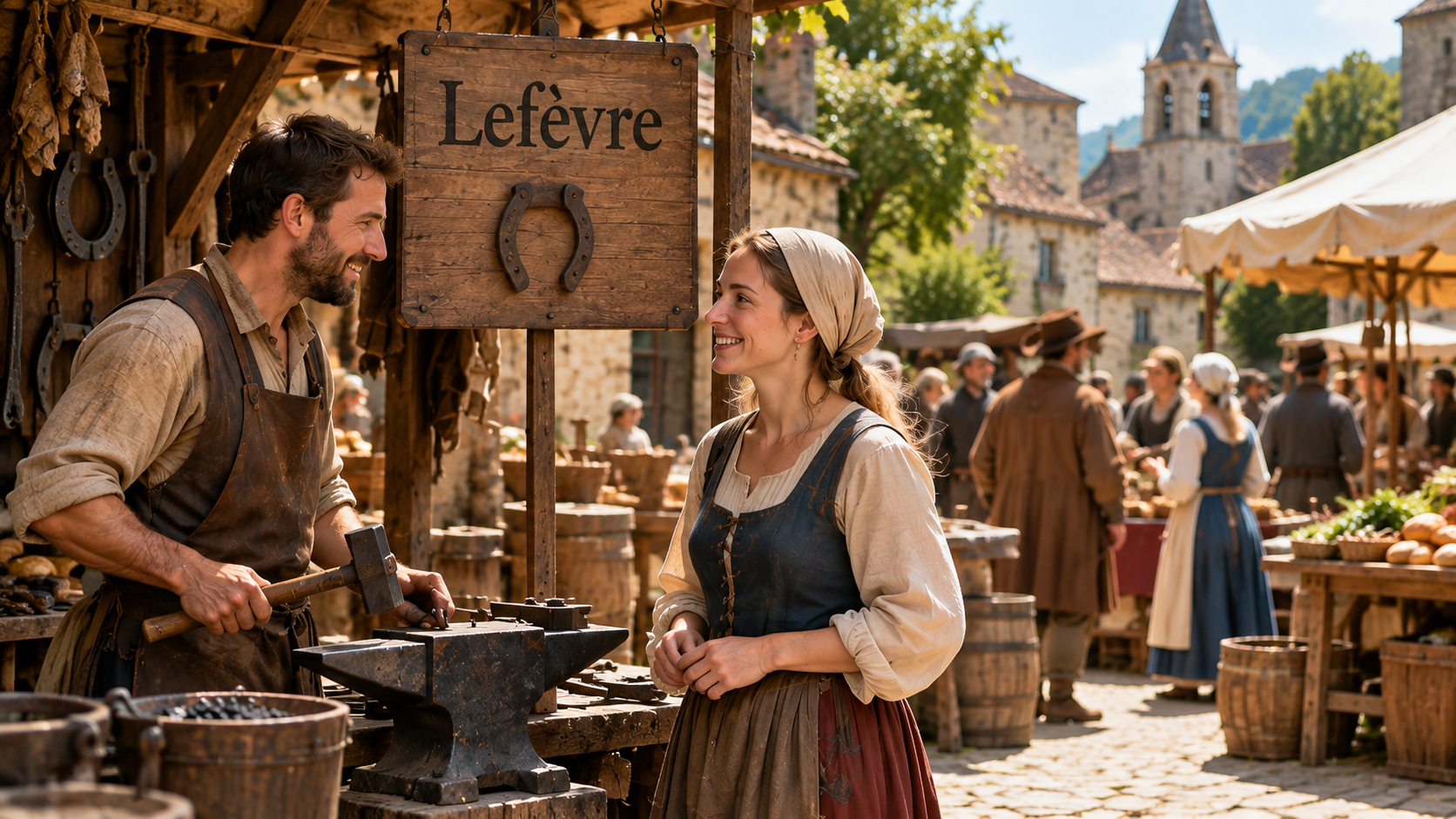
One example is the surname Lefebvre. This surname derives from the Old French word febvre / fèvre, which referred to a smith or blacksmith.
In modern French, a blacksmith is generally called a forgeron, so the word fèvre is rarely encountered in everyday language. Surnames such as Lefebvre, however, preserve traces of this older vocabulary.
In addition, because different languages and dialects have historically been used in different regions of France, surname spellings may also preserve regional characteristics. For example, the surname Lefèvre differs in spelling from Lefebvre, mentioned above, but the two share the same etymological origin.
Literary works and historical documents are important sources when studying the history of the French language, but surnames also preserve traces of older forms of French and regional languages. Therefore, when investigating the origins of surnames, it is important not only to look for similar words in modern French but also to consider Old French, regional languages, and historical spellings.
Many French surnames are connected to names or descriptions that were originally used to distinguish one individual from another.
The main points can be summarized as follows:
During the Middle Ages, population growth and social change increased the need to distinguish between people who shared the same personal name. As a result, additional names based on personal names, occupations, places of origin, places of residence, and other characteristics came into use.
Some of these names were subsequently passed down from one generation to the next, eventually developing into the surnames used today.