#18 The Position of French in the Age of English
Izumi Miyajima French Forest
French nouns have grammatical gender, and nouns referring to people may have distinct masculine and feminine forms. For example, a male student is referred to as étudiant, while a female student is referred to as étudiante.
How, then, should we write about a group that includes both men and women?
Traditionally, French has generally used masculine forms to refer to groups as a whole. In recent years, however, there has been growing interest in reconsidering this convention and making women and other people more explicitly visible in written language.
One prominent approach is known as écriture inclusive, or inclusive writing.
In this article, I will explain what inclusive writing in French is, the background behind it, some of its main forms, and the debates surrounding its use in the French language.
Inclusive writing is an approach that seeks to avoid treating one gender as the default in written language and to represent women and other people as equitably as possible. In French, it is known as écriture inclusive.
In French, the masculine plural has traditionally been used generically when referring to groups of people.
For example, a group containing both male and female students can be referred to as les étudiants. Grammatically, étudiants is the masculine plural form, but depending on the context, it can refer to a group of students that includes both men and women rather than only men.
Inclusive writing offers ways to avoid using only the masculine form generically or to make the feminine form explicit.
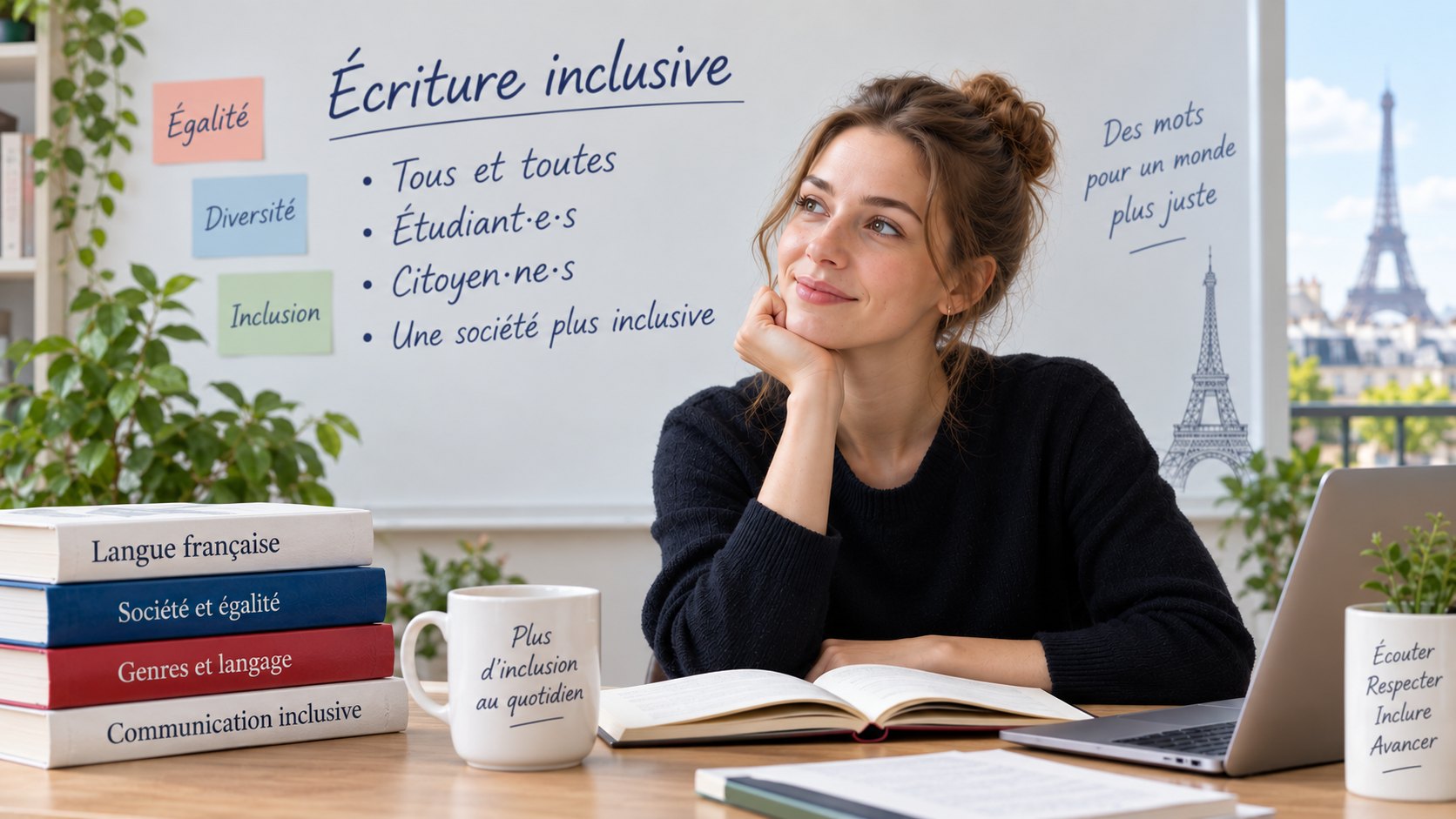
Using the previous example, one approach is to write both the masculine and feminine forms, as in les étudiants et les étudiantes.
Another method is to use the middle dot (point médian) to combine masculine and feminine forms into a single written form, as in les étudiant·es.
Inclusive writing can also involve replacing gendered expressions with more neutral or collective alternatives. For example, depending on the context, la communauté étudiante (the student community) may be used instead of les étudiants (students).
Inclusive writing therefore encompasses a variety of approaches, including writing masculine and feminine forms together and rephrasing sentences in ways that do not foreground gender.
There is no single prescribed method of inclusive writing. Approaches include writing both masculine and feminine forms, using symbols to combine them within a single word, and replacing gendered expressions with alternatives that minimize references to gender.
Below, I will introduce several common approaches.
One relatively simple and accessible approach is to write both the masculine and feminine forms.
Traditionally, a mixed-gender group would be referred to using only the masculine plural, as in les étudiants. By contrast, writing les étudiants et les étudiantes explicitly indicates that both men and women are included.
This practice of placing masculine and feminine forms side by side is known by terms such as doublet and double flexion.
Because it does not require special symbols, it is relatively easy to understand and can be read aloud as written. However, when such expressions appear repeatedly, they can make a text considerably longer.
One of the best-known forms of inclusive writing involves the middle dot “·,” known in French as the point médian.
Étudiant·e combines the masculine form étudiant and the feminine form étudiante into a single written form. In the plural, étudiant·es can be used as a form encompassing both étudiants and étudiantes.
This approach can make a text more concise than writing masculine and feminine forms separately. However, because it inserts a symbol within a word that does not appear in conventional French spelling, critics have argued that it can make reading and pronunciation more complicated.
Another approach is to use gender-neutral or collective expressions rather than explicitly presenting masculine and feminine forms.
For example, les étudiants (students) can be replaced in some contexts by la communauté étudiante (the student community).
Similarly, instead of les citoyens (citizens), a collective noun such as la population (the population / the public) may sometimes be appropriate.
This approach makes it possible to avoid foregrounding a particular gender without using special written forms such as étudiant·es.
However, rephrasing can sometimes alter the meaning. For example, les étudiants refers directly to individual students, whereas la communauté étudiante presents students collectively as a community.
It is therefore necessary to choose alternative expressions carefully while considering the intended meaning of the sentence.
One reason inclusive writing has attracted attention is the system of grammatical gender in French.
French nouns are generally either masculine or feminine, and words referring to people may also have distinct masculine and feminine forms. For example, “student” can be expressed as the masculine étudiant or the feminine étudiante, while “French” can take forms such as Français and Française when referring to people.
When a group contains both men and women, French conventionally uses the masculine plural as a generic form. The same principle applies to gender and number agreement: when a single adjective modifies both masculine and feminine nouns, the masculine plural form is conventionally used.
This system has prompted concerns that using masculine forms as gender-generic forms may make women less visible in language.
In particular, masculine forms referring to people can be used both for groups consisting only of men and for mixed-gender groups. Critics have therefore argued that, even when a masculine form formally includes both men and women, readers may be more likely to imagine a predominantly male group. As a result, the issue has come to be discussed not only in terms of grammatical structure but also in terms of how language represents people and society.
Occupational and professional titles have also become an important part of this discussion. As women’s participation across a wider range of professions has increased, debate has developed over whether feminine forms should be used more systematically for occupations and positions that were traditionally expressed primarily in the masculine. Changes involving feminine occupational titles are therefore also connected with the broader discussion of inclusive language.
Against this background, approaches have developed that make multiple genders explicit in writing rather than relying solely on a generic masculine form. These include writing both forms, as in les étudiants et les étudiantes, or using forms such as les étudiant·es. Another approach is to avoid directly gendered expressions by using more neutral collective nouns where appropriate.
However, the debate over inclusive writing does not mean that the traditional use of masculine forms is grammatically incorrect. The generic use of the masculine plural remains part of French grammar.
Rather, the debate concerns how people of different backgrounds should be represented in writing while taking the established grammatical system into account.
Inclusive writing can therefore be understood as part of a broader discussion about the relationship between grammatical gender, which has long been a feature of French, and contemporary approaches to gender and the representation of people in society.
In France, inclusive writing—and particularly forms involving the point médian— has remained the subject of debate involving the government, educational institutions, language authorities, and other organizations.
One significant development occurred in 2017. That year, the Académie française expressed strong concerns about inclusive writing, arguing that the increasing use of orthographic and syntactic markers could make texts more difficult to read and could create problems for reading, writing, and pronunciation.
In November 2017, then Prime Minister Édouard Philippe also issued a circular concerning writing conventions in administrative documents. The circular called for feminine forms of occupational and official titles when the positions were actually held by women and allowed paired forms such as le candidat ou la candidate in contexts such as job advertisements. At the same time, it instructed writers not to use forms of écriture inclusive that incorporate feminine forms into masculine forms through typographical symbols in texts published in the Journal officiel and similar official documents.
In other words, the 2017 government circular accepted practices such as feminine occupational titles and paired expressions like le candidat ou la candidate, while taking a more restrictive position toward combining masculine and feminine forms within a single word through dots or similar symbols.
A similar development occurred in education. In 2021, the French Ministry of Education issued a circular concerning language use in schools, establishing a policy against using or teaching certain forms of inclusive writing in which words are divided by middle dots, such as étudiant·e·s. Reasons cited included differences from conventional grammatical rules as well as concerns relating to reading aloud, comprehension, learning, and accessibility.
The Ministry’s policy was subsequently challenged in court. In December 2024, France’s Conseil d’État ruled that the 2021 circular prohibiting the use and teaching of certain forms of inclusive writing involving middle dots in schools was lawful.
The issue has also continued to be debated politically. In October 2023, the French Senate adopted at first reading a bill that sought to restrict the use of inclusive writing more broadly. The proposal covered forms that combine masculine and feminine endings within a single word using middle dots or similar devices, as well as newer pronouns such as iel, and included restrictions on their use in areas such as education and documents where the use of French is legally required.
However, the bill had only passed its first reading in the Senate, and as of September 2026, it had not become law.
Meanwhile, a separate legal dispute concerned the use of inclusive forms on a commemorative plaque at Paris City Hall. In 2025, the Paris Administrative Court of Appeal ruled that the forms used on the plaque could not be regarded as being outside the French language and that their use alone did not violate the principle of neutrality in public services.
In January 2026, another bill aimed at prohibiting inclusive writing was introduced in the French National Assembly.
Therefore, as of September 2026, inclusive writing as a whole is not uniformly prohibited by law in France. However, certain forms involving the middle dot are restricted in areas such as national administrative documents and school education.
The extent to which inclusive writing should be accepted therefore remains an ongoing subject of political and legal debate in France.
Inclusive writing, known in French as écriture inclusive, is an approach that seeks to represent different groups of people more equitably in written language.
The main points can be summarized as follows:
Inclusive writing has been the subject of continuing debate in France for many years.
Questions such as how men and women should be represented in language and how far changes in society should be reflected in standard French have made inclusive writing a significant topic in discussions about the relationship between the French language and contemporary society.