#45 French Terms Used in the Fashion Industry
Izumi Miyajima French Forest
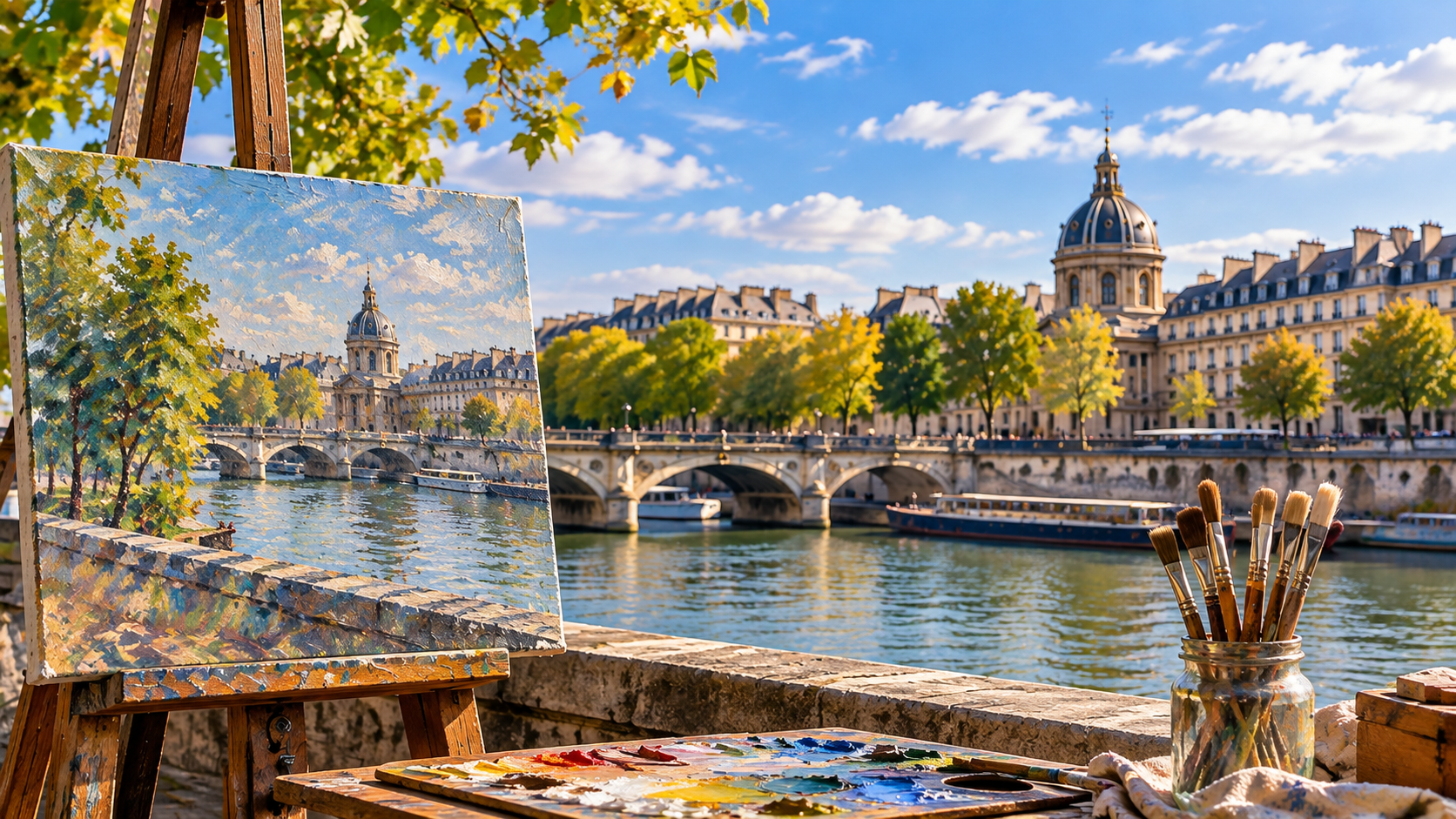
Throughout its long history, the French language has maintained a close relationship with art. It has been used in various artistic fields, including painting, sculpture, literature, theater, and cinema, playing an important role in expressing French culture and aesthetic sensibilities.
Many French words associated with art are still used in countries around the world today. For example, art, meaning “art,” and avant-garde, referring to innovative or experimental artistic activities and expressions, demonstrate the cultural influence of the French language.
In this article, I will explore the historical relationship between French and art, the characteristics of French as used in fields such as painting, literature, and cinema, and some representative French vocabulary associated with artistic expression.
The relationship between French and art is closely connected to France’s historical development as one of Europe’s major cultural centers.
In medieval France, various forms of artistic expression flourished, including religious architecture, illuminated manuscripts, and poetry. Gothic architecture, which began to spread around the twelfth century, developed particularly in northern France and influenced architectural traditions throughout Europe.
During the Renaissance, France experienced significant developments in painting, sculpture, architecture, and literature under the influence of Italian art and humanism.
In the second half of the seventeenth century, artistic activities flourished around the court of Louis XIV. Palaces and gardens were developed to demonstrate the prestige of the monarchy, while painting, sculpture, music, and theater became important elements of court culture.
During this period, French developed as a language of the royal court and literature, gradually becoming widely used in European diplomacy and among the upper classes.
In the eighteenth century, the spread of Enlightenment thought encouraged the development of a culture in which literature, theater, and the visual arts served as means of examining society and human nature.
By the nineteenth century, Paris had become one of Europe’s leading artistic cities, providing a setting for the development of various artistic movements, including Romanticism, Realism, and Impressionism.
Throughout this history, French developed not only as a language for creating works of art but also as a language for discussing, interpreting, and evaluating artistic expression.
From the seventeenth century onward, France gradually established institutions for artistic production and evaluation through royal art academies and exhibitions.
The Royal Academy of Painting and Sculpture (Académie royale de peinture et de sculpture), founded in 1648, had a particularly significant influence on the development of art education and artistic theory in France.
At the Academy, artists studied various genres of painting, including history painting, portraiture, and landscape painting. Particular importance was placed on techniques such as composition, perspective, and the representation of the human figure. Standards for evaluating works of art and theories of artistic expression also developed, contributing to the growth of art criticism in French.
In the eighteenth century, the Salon, an official art exhibition held in Paris, became an important venue for presenting and evaluating works of art.
During the nineteenth century, French painting underwent further significant changes. Artistic movements such as Romanticism and Realism developed, and painters increasingly turned their attention not only to history and mythology but also to natural landscapes and everyday life.
In the second half of the nineteenth century, Impressionism emerged in France.
Impressionism is called impressionnisme in French, and the name derives from Claude Monet’s painting Impression, soleil levant (Impression, Sunrise).
At the first group exhibition held by the artists in 1874, the critic Louis Leroy used the term “Impressionists,” drawing inspiration from the title of Monet’s painting. The name subsequently became established as the designation for the artistic movement.
Impressionist painters emphasized changes in light, color, and scenes from everyday life, pursuing forms of expression that differed from traditional painting.
For example, Claude Monet painted the same landscapes at different times of day and under different weather conditions, capturing the changing colors and impressions created by light.
Pierre-Auguste Renoir, meanwhile, depicted everyday life and human figures using bright colors, while Edgar Degas frequently chose subjects such as dancers and scenes of urban life.
Literature is an artistic field that has played an important role in the development of the French language.
French literature has a long history extending from the Middle Ages to the present day and has developed through various forms, including poetry, novels, and plays. Literary works have also enriched French vocabulary and methods of expression while contributing to the development of the written language.
During the Middle Ages, chivalric romances, epic poems, and religious works were written in Old French.
One representative example is La Chanson de Roland (The Song of Roland), an epic poem believed to have been composed around the late eleventh or early twelfth century. Depicting the courage and loyalty of knights, it is regarded as one of the representative works of medieval French literature.
In the sixteenth century, the influence of the Renaissance encouraged writers to explore the possibilities of literary expression in French.
In 1549, the poet Joachim du Bellay published La Défense et illustration de la langue française (The Defense and Illustration of the French Language), arguing that French should be developed as a language suitable for literature and scholarship.
During this period, poets such as Pierre de Ronsard also contributed to the development of increasingly rich poetic expression in French.
In the seventeenth century, Classical literature flourished, with prominent writers including Molière, Pierre Corneille, Jean Racine, and Jean de La Fontaine.
Classical literature emphasized elements such as structural organization, clarity of expression, and harmony.
Molière portrayed human character and social customs through comedy, while Racine explored human passions and conflicts through tragedy. La Fontaine, meanwhile, used fables to communicate observations and moral lessons about human society in an accessible manner.
In the eighteenth century, the spread of Enlightenment thought made literature an important means of examining society, politics, and religion.
Thinkers such as Voltaire and Jean-Jacques Rousseau discussed human freedom and the organization of society through literary works and critical essays.
The nineteenth century witnessed major developments in the novel, with writers such as Victor Hugo, Honoré de Balzac, Gustave Flaubert, and Émile Zola making significant contributions.
In works such as Les Misérables, Hugo depicted social inequality and human dignity.
Balzac portrayed the various social classes and human relationships of nineteenth-century French society through his collection of works known as La Comédie humaine (The Human Comedy).
Flaubert pursued precision and refinement in literary expression, while Zola made a major contribution to the development of Naturalist literature.
In the twentieth century, writers such as Marcel Proust and Albert Camus developed distinctive literary approaches to themes including human memory, existence, and society.
Proust’s À la recherche du temps perdu (In Search of Lost Time) is particularly well known as an extensive novel exploring memory and time.
In this way, French literature has developed while reflecting the society and intellectual movements of different historical periods, continually enriching the expressive possibilities of the French language.
France has also played a significant role in the history of cinema, producing numerous films and cinematic movements from the emergence of motion pictures to the present day.
The Lumière brothers are particularly important figures in the early history of cinema.
On December 28, 1895, the Lumière brothers organized a paid public screening of films using their cinematograph at the Grand Café in Paris.
This event marked an important milestone in the development of cinema as a form of entertainment and artistic expression presented to public audiences.
Subsequently, filmmaking techniques and methods of cinematic expression developed in France. Directors such as Georges Méliès produced films incorporating special effects and narrative elements.
During the twentieth century, cinema became increasingly widespread as a form of popular culture while also gaining recognition as an artistic medium.
A particularly influential development occurred from the late 1950s through the 1960s with the emergence of the cinematic movement known as the Nouvelle Vague.
Nouvelle Vague means “New Wave” in French.
Directors such as Jean-Luc Godard and François Truffaut departed from established filmmaking conventions and pursued new forms of cinematic expression.
They incorporated techniques such as location shooting, natural dialogue, and innovative editing methods, demonstrating new possibilities for the medium.
These films had a major influence not only on French cinema but also on filmmakers and cinematic cultures around the world.
France has also developed cultural initiatives that recognize cinema as an art form and support its continued development.
For example, the Cannes Film Festival, first held in 1946, is internationally recognized as a major film festival presenting cinematic works from countries around the world.
French contains a wide range of specialized vocabulary associated with art, some of which has been adopted into languages around the world.
Particularly between the eighteenth and twentieth centuries, France developed as one of the major centers of European artistic culture.
Many artists and writers gathered in Paris, where new artistic movements and techniques emerged.
As these artistic activities spread internationally, specialized French terminology also became widely recognized.
Even today, words derived from French are used in various languages, including Japanese, particularly in fields such as the visual arts, literature, and theater.
The following are some representative examples.
| French | English | Meaning |
|---|---|---|
| avant-garde | Avant-garde | Innovative or experimental artistic movements and expressions |
| impressionnisme | Impressionism | An artistic movement emphasizing the representation of light and color |
| surréalisme | Surrealism | An artistic movement exploring dreams, the unconscious, and unexpected forms of expression |
| collage | Collage | An artistic technique involving the arrangement and attachment of materials such as paper and photographs |
| atelier | Studio, workshop | A workspace used by artists and craftspeople |
| croquis | Quick sketch | A drawing made in a short period to capture the essential features of a subject |
| motif | Motif | A subject, theme, or recurring element in an artistic composition |
| genre | Genre | A category or classification of artistic works |
| chef-d’œuvre | Masterpiece | An outstanding or representative work |
| mise en scène | Mise-en-scène, staging | The arrangement and direction of elements in theatrical or cinematic production |
For example, avant-garde was originally a military term meaning “advance guard.”
It later came to be used in the arts to describe movements, works, and artists that challenge established forms of expression and pursue innovative artistic approaches.
Today, the term is used not only in the visual arts but also in music, theater, cinema, and other artistic fields.
The term impressionnisme, meaning “Impressionism,” derives from the French noun impression, meaning “impression.”
This illustrates how the names of artistic movements can develop from ordinary French vocabulary.
The term surréalisme, meanwhile, refers to an artistic movement that developed primarily in France during the twentieth century.
Surrealism is characterized by its interest in dreams and the unconscious mind, as well as its pursuit of forms of expression that extend beyond the constraints of rational thought.
French terms associated with artistic techniques include collage and croquis.
The word collage derives from the French verb coller, meaning “to stick” or “to glue.”
It refers to a technique in which materials such as paper, photographs, and fabric are attached to a surface to create an artistic composition.
Croquis refers to a quick sketch intended to capture the essential characteristics of a person, landscape, or other subject within a short period.
The term is also used in Japanese art education and drawing practice.
Another important word is atelier, which refers to an artist’s studio or workshop.
It describes a space where creative activities such as painting, sculpture, and design are carried out.
The word genre is also widely used in literature, cinema, music, and other fields to describe categories or classifications of artistic works.
Another notable expression is chef-d’œuvre, meaning “masterpiece.”
The word chef can mean “head,” “leader,” or “principal,” while œuvre means “work” or “creation.”
Historically, the term referred to a work produced by a craftsman to demonstrate professional skill. Today, it is used to describe particularly outstanding artistic works and other exceptional achievements.
In this way, French artistic terminology is used in various contexts, from the names of artistic movements to production techniques and the evaluation of works.
Learning the meanings and origins of these words can deepen our understanding of artistic expression while also revealing the influence that the French language has had on artistic cultures around the world.
Throughout its long history, French has maintained close connections with various artistic fields, including painting, literature, and cinema.
Many artistic terms derived from French are also used internationally today.
The most important points are as follows:
Understanding the relationship between French and art therefore provides an opportunity to explore not only vocabulary and grammar but also French history, culture, and aesthetic sensibilities.