#46 French and Culinary Culture
Izumi Miyajima French Forest
French is a language with deep connections to the world of fashion. For example, terms such as haute couture and prêt-à-porter originally come from French.
The prominent role that French has come to play in fashion is closely linked to the history of France, particularly Paris, which has long developed as one of the major centers of European clothing and fashion culture.
In this article, I will explore how French and fashion have become closely connected, while introducing some of the most common French terms used in the fashion world.
Today, cities around the world, including New York, London, Milan, and Paris, are widely recognized as major centers of fashion.
Among them, Paris has had a significant influence on European clothing and fashion culture throughout its long history. This history also helps explain the close relationship between the French language and fashion.
In the seventeenth century, particularly during the reign of Louis XIV, an elaborate court culture developed around the Palace of Versailles. At the royal court, clothing served not only to cover the body but also as an important means of expressing rank, wealth, and social status.
The clothing, hairstyles, and accessories of the French court attracted attention from abroad, and fashions originating in France spread to royal courts and upper-class society throughout Europe. As a result, French words associated with clothing and fashion also became increasingly familiar outside France.
France also developed industries related to fashion, including silk textiles, lace, ribbons, and jewelry. The combination of these industries with court culture strengthened France’s position as one of Europe’s leading centers of fashion and trends.
By the nineteenth century, the industry of producing high-quality clothing for individual clients had developed further in Paris. During this period, a new system emerged in which designers created their own designs and presented them to clients, helping to establish the foundations of the modern fashion designer’s role.
Parisian fashion was subsequently introduced to international audiences through magazines, fashion shows, and other media. By the twentieth century, French designers and fashion houses had gained worldwide influence.
Because of this long history, French-derived terms such as haute couture, prêt-à-porter, and atelier are still used internationally in the fashion industry today.
In other words, the close relationship between French and fashion developed through a long history involving court culture, the clothing industry, designers, and Paris’s role as a major center of fashion.
French has a wide range of words for different types of clothing. Some commonly used examples include:
| French | English |
|---|---|
| vêtement | clothing / garment |
| robe | dress |
| jupe | skirt |
| chemise | shirt |
| tee-shirt / T-shirt | T-shirt |
| pantalon | trousers / pants |
| jean | jeans |
| veste | jacket |
| manteau | coat |
| pull | sweater / jumper |
| chaussures | shoes |
| chapeau | hat |
It is important to note that French nouns referring to clothing have grammatical gender. However, their grammatical gender is not determined by whether the item is intended for men or women. The gender of each noun must therefore be learned individually.
Another point to keep in mind is that some words look similar in French and English but have different meanings.
For example, the French word robe generally means “dress,” whereas the English word robe usually refers to a loose garment such as a bathrobe.
Although French and English share many terms related to fashion, relying solely on your knowledge of English to guess the meaning of a French word can sometimes lead to misunderstandings.
One of the main French words for “fashion” or “trend” is mode.
In the context of fashion, mode refers to clothing, styles, and trends that are popular in a particular period or society. It appears in expressions such as:
One common expression using mode is à la mode, meaning “fashionable” or “in fashion.” It is often used when discussing clothing, colors, or styles.
By contrast, the adjective démodé / démodée can be used to describe something that is “out of fashion” or “outdated.”
It is also important to note that mode is feminine when it means “fashion” or “trend,” so it is used as la mode.
French also has the masculine noun mode, which has a different meaning, such as “method,” “mode,” or “way.” For example, le mode de paiement means “method of payment.”
Thus, although the spelling is identical, la mode refers to “fashion” or a “trend,” while le mode refers to a “method,” “mode,” or “way,” with the grammatical gender distinguishing the meanings.
While mode refers to “fashion” or a “trend,” vêtement refers to an actual item of clothing.
The word vêtement is a general term for clothing worn on the body, such as shirts, trousers, and coats. When referring to a single item of clothing, un vêtement is used, while the plural des vêtements is commonly used when referring to clothes in general.
The verb porter is used to describe the state of wearing something. Its meaning is similar to the English verb “wear.”
By contrast, the reflexive verb s’habiller is used to describe the act of getting dressed.
The verb mettre is also commonly used when describing the action of putting on a particular item of clothing.
French therefore distinguishes between vêtement, which refers to an item of clothing; porter, which describes the state of wearing something; and s’habiller, which refers to the act of getting dressed.
One of the terms that best illustrates the connection between French and fashion is haute couture, which refers to exceptionally high-quality clothing made for individual clients using highly specialized techniques, as well as the sector of the fashion industry devoted to such clothing.
The term haute couture combines haute, meaning “high” or “elevated,” with couture, meaning “sewing” or “dressmaking.”
Unlike ready-made clothing, which is produced in quantity in predetermined designs and sizes, haute couture garments are created for individual clients through processes such as taking measurements and conducting fittings. Highly skilled craftspeople are involved in their production, and extensive handwork is often used for embroidery and other decorative details.
The system of haute couture that developed into its modern form emerged in Paris during the second half of the nineteenth century. During this period, a new approach to dressmaking became increasingly established in which designers presented clients with their own original designs, from which the clients could make their selections. This development also increased the importance placed on the designer’s creativity and the distinctive identity of a fashion house.
In France, the designation Haute Couture is legally protected, and fashion houses must receive official authorization to use it. The criteria for this designation include requirements concerning the production of made-to-order garments for individual clients, work carried out in an atelier in Paris, and the regular presentation of collections.
In this way, haute couture is deeply connected to the clothing industry that developed around Paris, the skills of specialist craftspeople, and the creative culture of fashion designers.
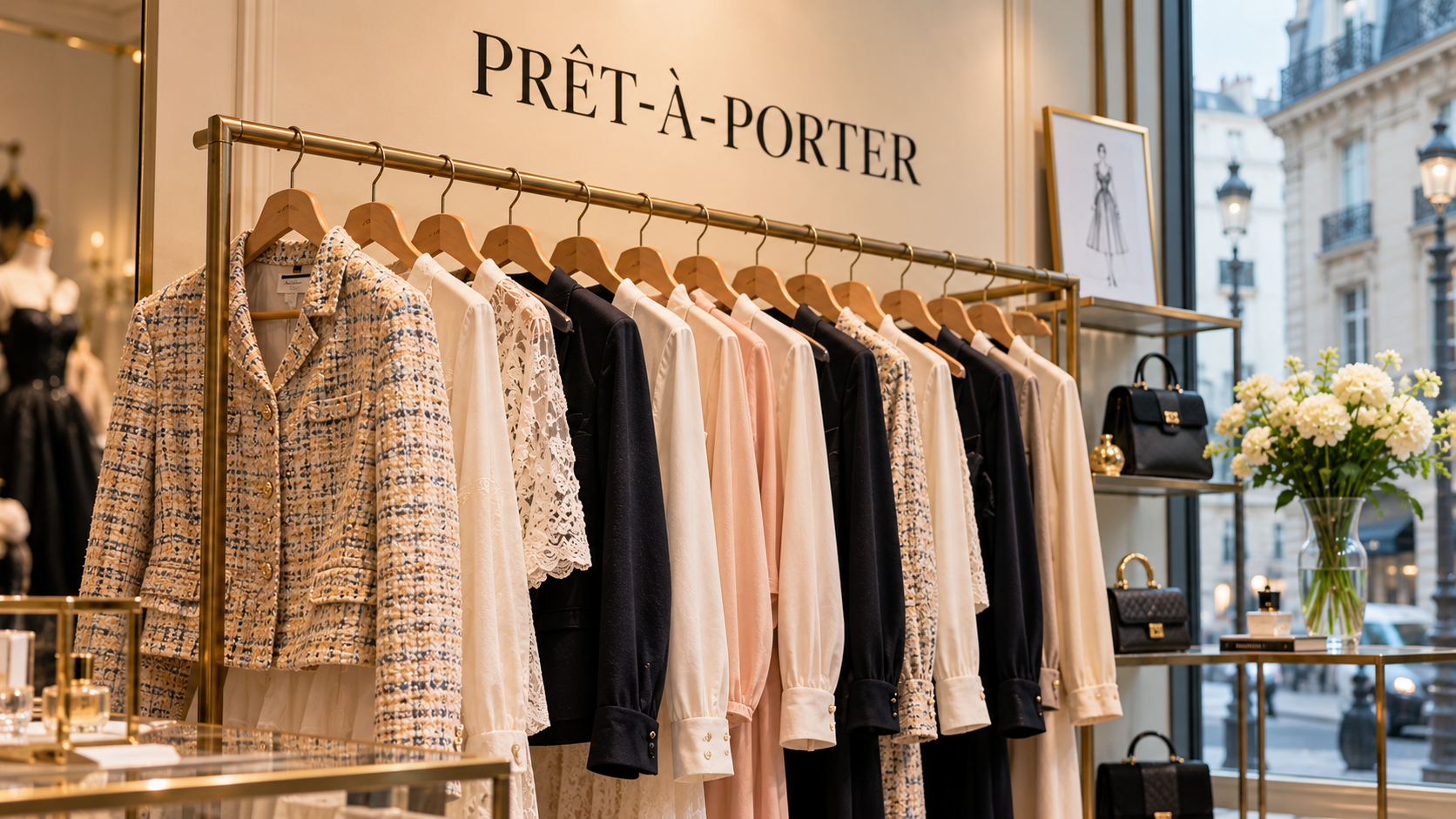
Another term frequently used alongside haute couture is prêt-à-porter.
Prêt means “ready,” while porter means “to wear.” The construction prêt à + infinitive means “ready to do something.” Prêt-à-porter can therefore be understood literally as “ready to wear.”
The verb porter used here means “to wear.” For example, porter une robe means “to wear a dress,” while porter un chapeau means “to wear a hat.”
In fashion, prêt-à-porter refers to ready-made clothing that is designed and produced in predetermined sizes rather than being individually made to order for each client.
For this reason, it is often contrasted with haute couture, which is created for individual clients. However, prêt-à-porterdoes not necessarily mean inexpensive clothing. It includes both ordinary clothing and ready-to-wear collections produced by luxury fashion houses.
Furthermore, while haute couture is created for a limited number of clients, ready-to-wear clothing can be produced in standardized sizes, allowing fashion houses to make their designs available to a much wider audience. The ready-to-wear market expanded considerably during the twentieth century, and prêt-à-porter became an important part of the modern fashion industry.
The French words atelier and maison are also commonly used in the fashion industry.
Atelier means a “workshop” or “studio.” In fashion, it refers to a place where designers and craftspeople create garments, particularly where processes such as tailoring and sewing are carried out.
Haute couture, for example, involves many stages beyond designing a garment, including cutting fabric, sewing, embroidery, and decorative work. An atelier is the place where skilled craftspeople carry out these specialized tasks.
Maison, on the other hand, generally means “house” in French. In the fashion industry, however, it can refer to a fashion house, brand, or company.
In this context, maison can also suggest the traditions, craftsmanship, and distinctive style that a particular brand or company has developed over many years. For this reason, the term is often associated particularly with established luxury fashion houses.
In short, while atelier primarily refers to the place where garments and other items are physically created, maison refers more broadly to the fashion house or organization responsible for the brand and its work.
French and fashion have a close relationship that has developed over a long period of history.
As French clothing and fashion culture, centered particularly on Paris, influenced Europe and the wider world, numerous French terms became established in the international fashion industry and continue to be used today.
The main points covered in this article can be summarized as follows:
By learning about the background of familiar terms such as haute couture and prêt-à-porter, we can gain a deeper understanding of how French culture has influenced languages and everyday life around the world.