#30 French Conversation Etiquette
Izumi Miyajima French Forest
In French, a person’s given name is called a prénom, while a surname is called a nom or nom de famille. These terms correspond broadly to first name / given name and family name / surname in English.
Some people in France also have multiple given names. In addition, when it comes to surnames after marriage, French naming conventions distinguish between a surname officially registered at birth or through filiation and a surname that may be used in everyday life.
When learning French, it is useful not only to understand the meanings of words such as prénom and nom, but also to know how names are actually used in France.
In this article, I will introduce the basic structure of French names, including the distinction between given names and surnames, compound given names, surnames after marriage, and forms of address.
French names are generally written in the order “given name + surname.” For example, in the name Marie Dupont, Marie is the given name and Dupont is the surname.
This is the same order as first name + last name in English, making the basic structure relatively easy for English speakers to understand.
In French, a person’s given name is called a prénom. This corresponds to first name or given name in English. A surname, on the other hand, is called a nom or nom de famille, corresponding to surname or family name in English.
One word that requires particular attention when learning French is nom. Because it resembles the English word name, learners may assume that it refers to a person’s full name. However, when distinguishing between a given name and a surname, nom generally refers to the surname.
Therefore, if a French administrative document or application form contains fields labelled Nom / Prénom, you should enter your surname in the Nom field and your given name in the Prénom field.
To ask someone for their given name in French, you can say:
To ask for someone’s surname, you can use the following expressions:
To ask someone’s name more generally, you can say:
In this way, French names basically consist of a given name and a surname and are normally written in the order “given name + surname.” However, because Nom and Prénom are often presented as separate fields on forms and other documents, it is important to understand what each term means.
Some given names used in France combine two names to form a single given name. In French, such a name is called a prénom composé (compound given name).
Common examples include:
For example, in the name Jean-Pierre Martin, Jean-Pierre as a whole is the given name, while Martin is the surname.
In traditional compound given names, the two elements are often joined with a hyphen. Jean and Marie, in particular, have historically been combined with many other names, producing compound names such as Jean-Pierre, Jean-Claude, Marie-Claire, and Marie-France.
For this reason, when writing another person’s name, it is important to use the spelling and form that the person officially uses rather than adding or removing a hyphen based on your own assumptions.
The surnames used in France have a long history.
At one time, it was possible to identify individuals by their given names alone. However, as populations grew and more people shared the same given names, additional ways of distinguishing one person from another became necessary.
Words referring to a person’s occupation, place of origin, or parent’s name therefore began to be added to individual names. Some of these additional names were passed down through generations and eventually developed into the surnames used today.
For example, some French surnames originated from occupations. Boulanger means “baker” in French, while Bergermeans “shepherd.” Although these words are now used as ordinary surnames, they originally referred to a person’s occupation.
English also has occupational surnames such as Baker and Smith, so the underlying principle is relatively similar.
Other surnames originated from the personal names of ancestors. In such cases, a person was once distinguished from others by reference to the name of their father or another ancestor, and this form of identification later became established as a surname.
Some surnames are also associated with a person’s place of origin or residence. Their origins may lie not only in the names of villages or regions but also in words describing geographical features or the surrounding environment.
Other surnames developed from descriptions of a person’s appearance or characteristics. For example, Legrand is derived from the French word grand (“large” or “tall”), while Leblanc is related to blanc (“white”). Such descriptions may originally have been used to distinguish individuals before eventually becoming established as surnames.
French surnames may therefore have origins such as the following:
These patterns of surname formation are not unique to France and can also be found in English and various other European languages.
Today, of course, a person with the surname Boulanger is not necessarily a baker, and the original meaning of a surname generally has no direct connection with the occupation or characteristics of the person who currently bears it. Nevertheless, examining the origins of surnames can provide insight into how people in the past reflected occupations, places of origin, family relationships, and other characteristics in personal names.
An important aspect of the French naming system is the treatment of surnames after marriage.
In France, a person retains their existing nom de famille after marriage. However, after getting married, a person may use their spouse’s surname as a nom d’usage.
A nom d’usage is a surname that may be used in everyday life and in certain administrative contexts in addition to a person’s nom de famille. In other words, the system allows a person to retain their own surname while using another surname in everyday or administrative contexts.
For example, if Marie Dupont and Jean Martin marry, Marie may use her spouse’s surname, Martin, as her nom d’usage. She may also use a combination of her own surname and her spouse’s surname as her nom d’usage.
This system is not limited to women. Married spouses may each use the other spouse’s surname as a nom d’usage, subject to the applicable rules.
Using a nom d’usage is also optional. A person may continue to use only their own nom de famille after marriage.
French naming conventions therefore distinguish between the nom de famille and the nom d’usage, which may be used differently depending on the context.
In France, a child may receive either the father’s or the mother’s surname, or a combination of both parents’ surnames.
For example, if the father’s surname is Martin and the mother’s surname is Dupont, provided the relevant conditions are met, the child’s surname can generally take one of the following four forms:
In this way, a child may use the surname of either parent or a combination of both surnames.
There are also rules concerning the surnames of siblings. For children born to the same parents and subject to the same circumstances, the surname chosen for the first child generally also applies to subsequent children.
In French, the way a person is addressed varies according to the relationship between the speakers and the context of the conversation.
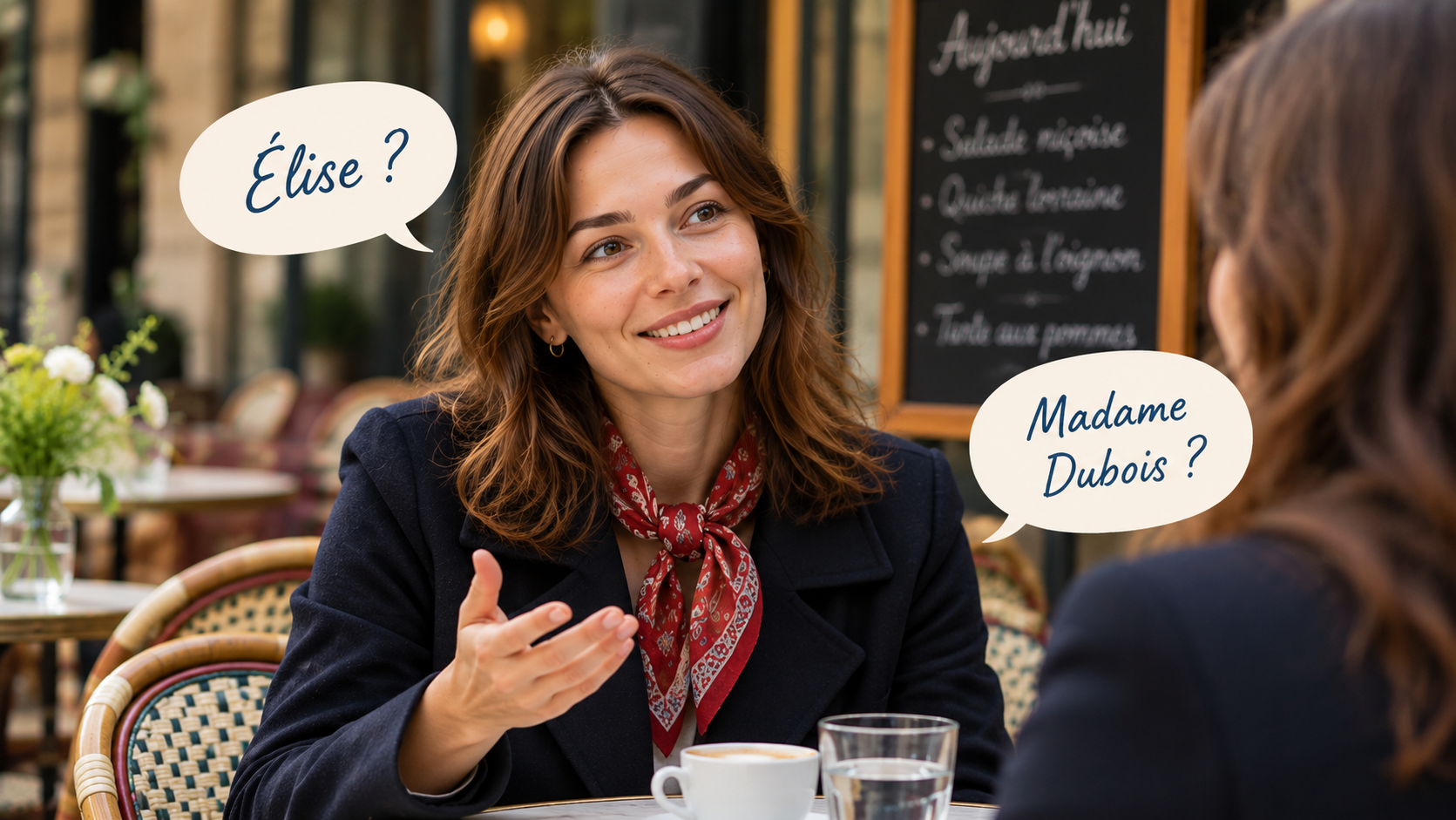
In professional relationships and formal situations, Monsieur or Madame may be combined with a person’s surname.
Monsieur is a title used for men, while Madame is used for women. For example, someone whose surname is Martin may be addressed as Monsieur Martin or Madame Martin. These forms are broadly comparable to Mr Martin and Ms Martinin English.
In French, Monsieur and Madame are also frequently used on their own as forms of address without a surname.
By contrast, friends, family members, and people with close relationships generally address one another by their given names.
In this way, the choice between addressing someone by their given name and using a title with their surname can reflect the degree of familiarity and the nature of the relationship between speakers.
French names basically consist of a given name and a surname. France also has particular naming conventions involving compound given names and the use of surnames after marriage.
The main points can be summarized as follows:
Understanding the difference between prénom and nom is useful not only when introducing yourself but also when completing application forms and administrative documents.
Furthermore, learning about conventions such as compound given names and the nom d’usage can provide a deeper understanding of the French society and culture behind these naming practices.