#54 French and Art
Izumi Miyajima French Forest
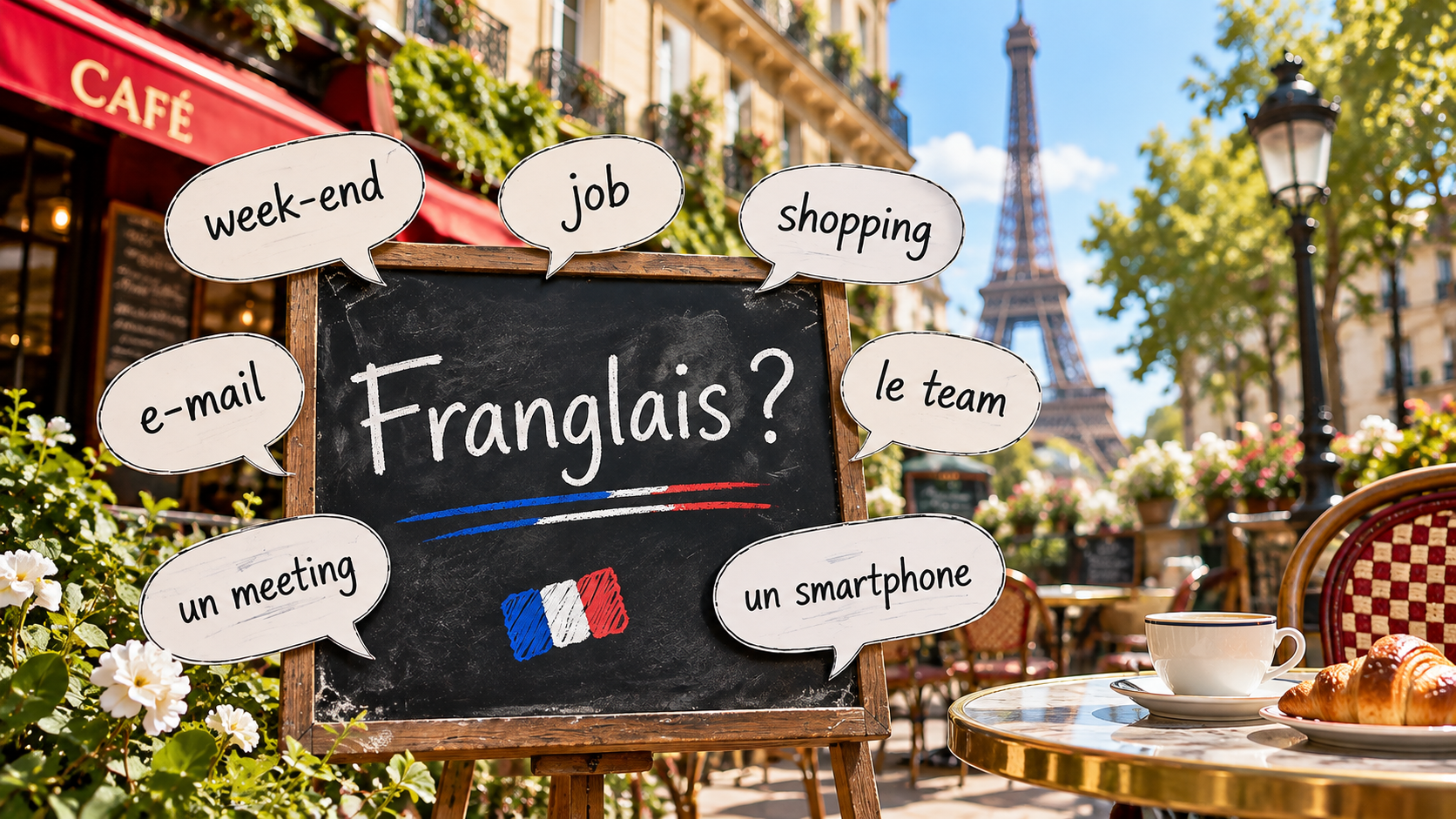
The French language contains numerous words and expressions borrowed from English.
For example, English-derived words such as week-end (weekend), job (job or work), and shopping (shopping) are commonly used in everyday French.
French that incorporates a significant number of English-derived words and expressions is sometimes referred to as “Franglais.”
Franglais is a linguistic phenomenon that has emerged through contact between French and English. It is an interesting subject for understanding how language is changing in modern French society.
English-derived vocabulary is particularly widespread in fields such as business, the internet, fashion, and music.
At the same time, France has a long tradition of emphasizing the protection and development of the French language, and the question of how English-derived expressions should be treated has been the subject of considerable debate.
In this article, I will explain the basic meaning of Franglais, introduce specific examples, and explore its historical background and use in modern society.
The word franglais is formed by combining français, meaning “French,” and anglais, meaning “English.”
In general, it refers to the use of English words and expressions in French sentences or conversations, or to the mixing of French and English.
An example of Franglais is the following sentence:
This sentence follows French grammatical rules but contains two words of English origin: shopping and week-end.
The following expression may also be used in business contexts:
In this example, meeting is a word borrowed from English. In French, réunion is also widely used to refer to a meeting.
Thus, a characteristic feature of Franglais is the incorporation of English-derived vocabulary into sentences that otherwise follow French grammar and sentence structure.
One of the main factors behind the widespread adoption of English-derived vocabulary in French was the growing international influence of English from the twentieth century onward.
During the nineteenth century, English words were already entering French through British industry, sports, and everyday culture. In the twentieth century, the increasing economic and cultural influence of the United States created further opportunities for English-derived expressions to enter the French language.
This influence became particularly significant after the Second World War, as American films, music, fashion, and advertising gained an increasingly prominent position in French society.
Alongside Hollywood films and jazz, which had already been introduced to France, rock music and other forms of American popular culture became more widespread. As a result, French speakers encountered English words and expressions more frequently, and English-derived vocabulary gradually spread into youth culture and everyday conversation.
During the 1950s and 1960s, American management practices and consumer culture also became increasingly influential, encouraging the use of English terminology in business and advertising.
As the growing presence of English attracted attention, the French literary scholar and critic René Étiemble published Parlez-vous franglais ? (“Do You Speak Franglais?”) in 1964.
The book critically examined the increasing use of English-derived expressions in French and helped bring the term franglais to wider public attention.
During the second half of the twentieth century, economic globalization and advances in computer technology further strengthened the role of English in international business, science, and technology.
Consequently, English-derived business terms such as marketing and management became widely used in French.
From the 1990s onward, the spread of the internet extended the influence of English into an even broader range of activities. Through email, websites, online games, and social networking services, new English-derived expressions became part of everyday French usage.
Today, English-derived vocabulary continues to spread through video streaming, social media, and international business activities.
The development of Franglais can therefore be understood in relation to several major historical changes, particularly the influence of American culture after the Second World War, economic globalization, and the development of digital technologies.
Numerous English-derived words appear in everyday French conversation. Such expressions are particularly common when discussing familiar subjects such as work, shopping, fashion, and entertainment.
Some representative examples are shown below:
| English-Derived Expression | Meaning | French Equivalent |
|---|---|---|
| week-end | weekend | fin de semaine |
| shopping | shopping | achats |
| job | job, work | travail, emploi |
| look | appearance, fashion style | apparence, style |
| cool | cool, nice | sympa, chouette |
| parking | parking lot | parc de stationnement |
| courriel | ||
| challenge | challenge | défi |
These words have become integrated into French grammar and are used naturally in everyday conversation.
As these examples illustrate, English-derived words are used in combination with French articles, prepositions, verbs, and other grammatical elements.
The frequency with which English-derived words are used also varies by region.
For example, week-end is widely used in France, whereas fin de semaine is more common in Quebec, Canada.
Similarly, while mail is commonly used to refer to email in France, courriel is particularly widespread in Quebec and is also used in official written communication in France.
The spread of the internet and social media has also played an important role in the development of Franglais.
English-derived expressions are particularly common in fields such as video streaming, online gaming, music, and fashion.
One reason for this is the widespread use of English on the internet and the fact that people around the world use the same digital services and consume similar content.
On social media and video-sharing platforms, new expressions originating in English can quickly spread among French-speaking users and sometimes become established parts of everyday language.
Common examples include:
Many of these expressions have been formed by adding French verb endings to English words.
For example, liker is formed by adding the French verb ending -er to the English word like. Similarly, streamer is a verb derived from the English word stream.
Such verbs are conjugated in the same way as regular French first-group verbs ending in -er.
English-derived expressions are also common in online gaming and conversations among younger people.
In gaming communities, for example, words such as game (a game or match) and skin (a design that changes the appearance of a character, weapon, or other game element) are frequently used. On social media, English expressions and abbreviations may also be incorporated directly into French sentences.
However, the popularity of particular expressions varies according to generation, community, and the platforms people use. Internet vocabulary also changes rapidly, with new words continually emerging.
Although English-derived vocabulary has become widespread in everyday French, there is also a strong tradition in France of emphasizing the protection and development of the French language.
This reflects the close relationship between the French language and the country’s history, culture, and national identity.
France has a long tradition of treating language as an important part of its cultural heritage. While French continues to be influenced by other languages, efforts are also made to preserve and develop its distinctive vocabulary and expressions.
One of the most prominent institutions associated with this tradition is the Académie française, established in 1635.
The Académie française provides guidance on French vocabulary and usage and contributes to the development of the language through activities such as compiling dictionaries.
In recent years, it has particularly emphasized the importance of using existing French vocabulary and appropriate French expressions in response to the increasing prevalence of English-derived terminology.
Another important development was the adoption of the Toubon Law (loi Toubon) in France in 1994.
This law requires the use of French in certain contexts, including consumer product information, advertising, and employment-related documents.
Its purpose is to ensure that French speakers can access and understand essential information in French.
In addition, government institutions and other organizations have worked to establish French equivalents for specialized terms borrowed from English.
For example, courriel has been proposed and recommended as a French equivalent of e-mail, while mot-dièse has been promoted as an alternative to hashtag.
These efforts aim to ensure that French can continue to be used effectively to communicate information in emerging fields, including science, technology, and economic activities.
At the same time, English-derived expressions such as week-end and shopping remain widely used in everyday conversation.
Some people regard these borrowed words as convenient and modern expressions, while others prefer to use established French vocabulary whenever possible.
French society therefore continues to experience two developments simultaneously: efforts to protect and standardize French vocabulary and the growing use of English-derived expressions in everyday life.
The debate surrounding Franglais extends beyond questions of vocabulary and usage. It is also closely connected to the cultural value of the French language and the role of languages in an increasingly international society.
Franglais refers to the use of English-derived words and expressions in French or to the mixing of French and English in speech and writing.
Its main characteristics can be summarized as follows:
Words and expressions borrowed from English are now used in many areas of French society, including everyday conversation, business, the internet, music, and fashion.
Understanding Franglais therefore provides valuable insight into the characteristics and ongoing development of modern French.